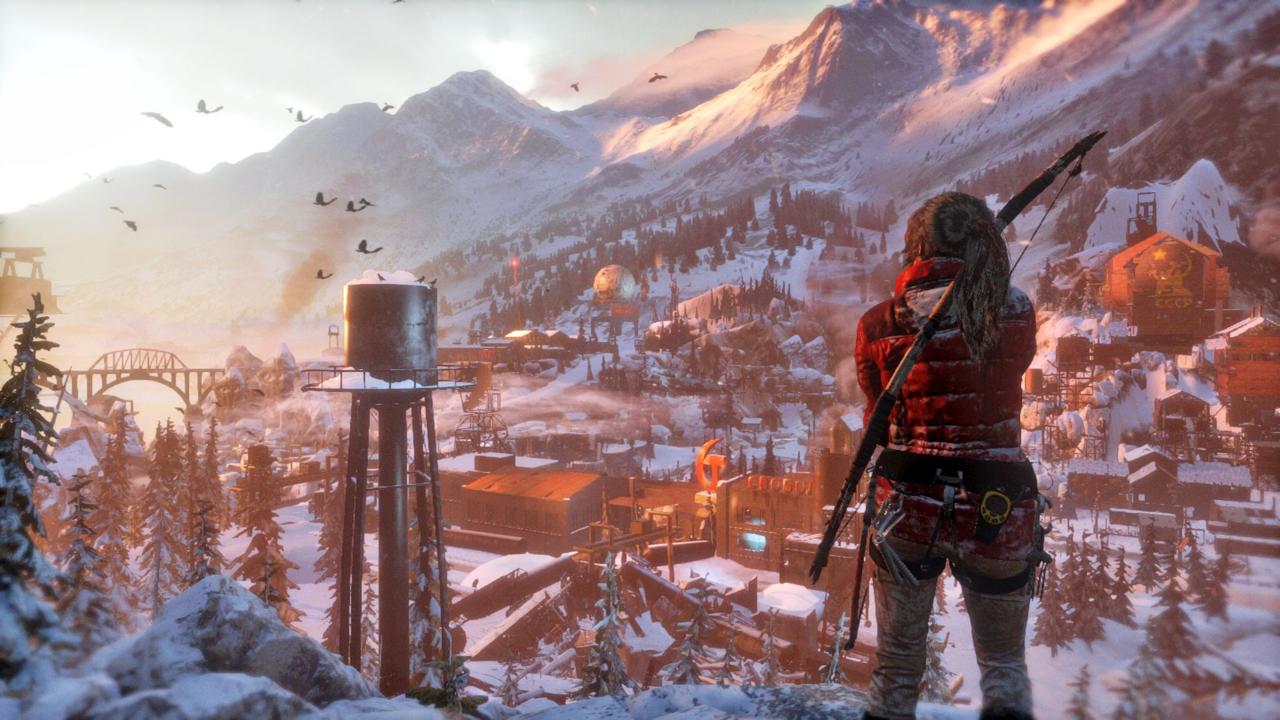
The trailer, which you can watch below, shows Lara making a perilous climb up the side of a mountain, overcoming the elements to reach a cave which, judging from the voice over emphasising “discovering the secrets of the world,” she goes on to raid thoroughly.
The trailer also teases a full reveal during Microsoft’s E3 press conference on June 15.
Although neither Sony nor Square Enix have talked about Rise of the Tomb Raider on other platforms, it is possible the game could come to PlayStation 4 or PC sometime down the road.
Rise of the Tomb Raider is being developed by Crystal Dynamics and is a direct sequel to 2013’s Tomb Raider reboot, which has sold more than 8.5 million copies, making it the best-selling Tomb Raider game of all time.
Later this month, the focus of the gaming world will be on E3 in Los Angeles, but that’s not the only gaming show this summer. Xbox company Microsoft has now said it preparing to have a major presence at Gamescom in Germany this August, promising a breadth of content as significant as what we’ll see at E3.
“We should have as much new content at Gamescom as we will at E3,” Xbox boss Phil Spencer said to a fan on Twitter who asked if Microsoft would be holding some major reveals for Gamescom.
Spencer didn’t elaborate further about Microsoft’s plans for Gamescom, which will be held this year in Cologne, Germany August 5-9. Unlike E3, Gamescom is open to the public, and historically draws crowds in the hundreds of thousands.
This news may not come as much of a surprise, as Microsoft has a history of making blockbuster reveals and announcements at Gamescom.
This isn’t the first time Microsoft has talked up its Gamescom showing. The company previously said that its 90-minute E3 show won’t include everything it wants to talk about, meaning some reveals will be saved for Gamescom.
“This year, we have an amazing games lineup to share (who knew it’d be so hard to pack all of our exclusive E3 premieres into an hour and a half?),” Microsoft said last month. “So we’re saving a lot of exciting reveals for Gamescom in August.”
It’s the first of the month, which means June’s free Games With Gold titles are now available for Xbox Live Gold subscribers across Xbox 360 and Xbox One.
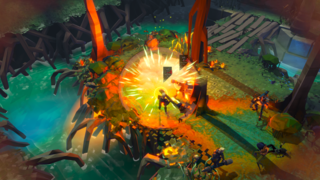
What’s notable about Massive Chalice is that today, June 1, actually marks the game’s release date.
Xbox 360 owners, meanwhile, can grab Avalanche Studios’ excellent sandbox game Just Cause 2 for free through June 15.
At school or work? Click through the links below to queue up your download from the Xbox Online Marketplace. Alternatively, you can start your download through the SmartGlass app.
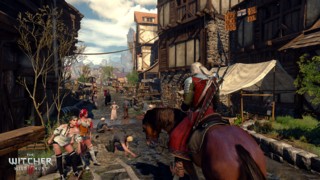
The update will include a fix for the XP bug that first came to light last week, along with “significantly enlarged” GUI and HUD elements, including fonts, to resolve the game’s small, hard-to-read text issue.
Also included are “general stability and performance improvements.” And you may be happy to learn that Geralt will no longer interact with candles near chests, which I’ve found to be somewhat annoying.
The list below represents only the “most requested changes” and not everything that will be included with 1.04/1.05.
And looking beyond 1.04/1.05, CD Projekt Red said it has “a lot more fixes on the way,” though none were named outright.
Witcher 3 1.04/1.05
Geralt will no longer interact with candles near chests and other interactive element
General stability and performance improvements
Significantly Enlarged GUI and HUD elements (including fonts) on consoles and slightly on PC.
Improved camera smoothness
Performance improvements during some cutscenes
Fixed case where game was crashing on loading a save in certain situations
Various bug fixes and user experience improvements in GUI panels.
Fixed issue where some players were unable to run after Wandering in the Dark quest
Fixed issue where players were unable to talk to Eight after the Lord of Undvik quest
Too many wild hunt minions were spawned during Ciri’s Story: Fleeing the Bog quest.
Fixed issue where Keira could sometimes fall under terrain during Wandering in the Dark quest
Fixed issue where Player was unable to move freely during Blindingly Obvious quest
Fixed issue where Player was unable to activate portal during Wandering in the Dark quest
Fixed issue where Player could get trapped in Turseach castle ruins
Fixed issue where Roche was not present at Hanged Man’s tree during Eye for an Eye quest
Fixed issue where Player was unable to talk or interact with certain NPCs
Fixed issue where Sirens in quest Lord of Undvik could be invulnerable
Fixed issue where player was unable to use certain actions after Carnal Sins quest
Fixed issue where Geralt was sometimes unable to mount Roach
Fixed issue where some players where experiencing infinite loading screen during King’s Gambit quest.
Fixed issue where Simun was not properly spawned in An Unpaid Debt quest
Fixed issue where player might have had a progression break after choosing certain dialogue option when talking to Dijkstra in Count Reuven’s Treasure quest
The Pyres of Novigrad quest is of course going to be fixed as well as the XP glitch
GameSpot’s early access reviews evaluate unfinished games that are nonetheless available for purchase by the public. While the games in question are not considered finished by their creators, you may still devote money, time, and bandwidth for the privilege of playing them before they are complete. The review below critiques a work in progress, and represents a snapshot of the game at the time of the review’s publication.
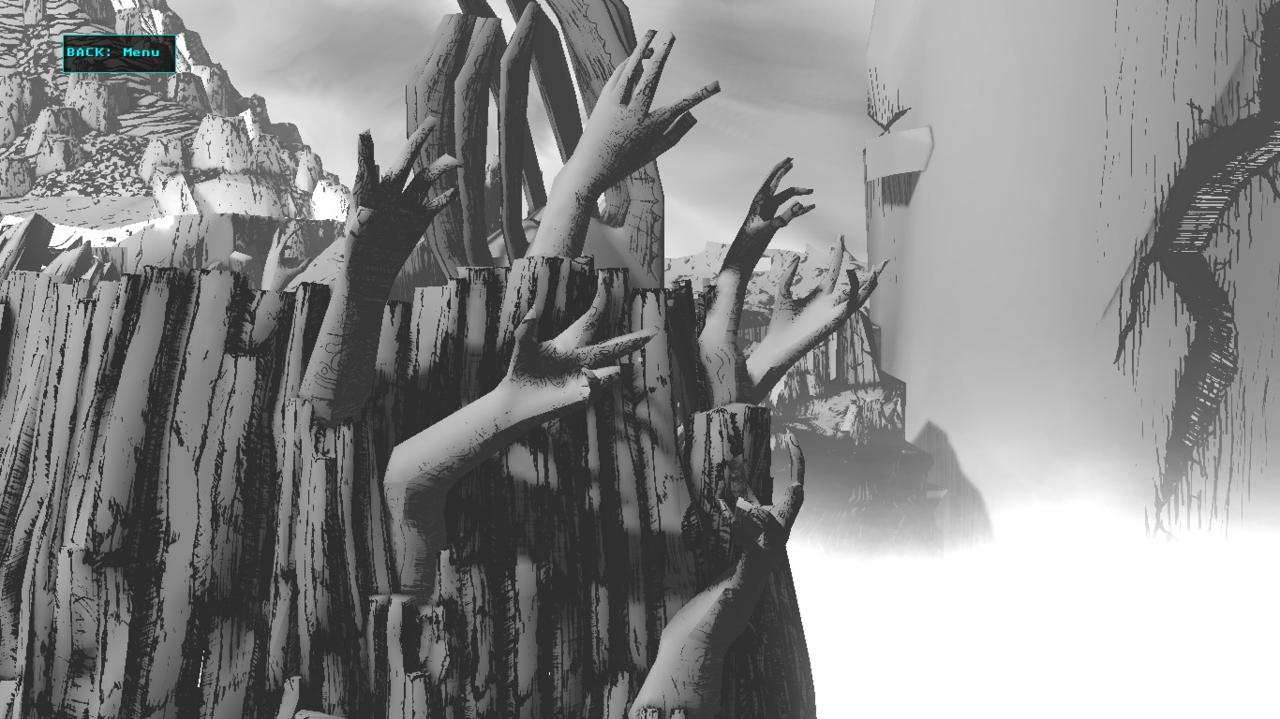
Like with any scene of disaster, it’s hard to avert your eyes from The Magic Circle. The monochrome world it depicts is a shambles of spectacular proportions, so thoroughly misjudged that there’s an almost perverse allure to it. Here, the genres of high-fantasy and sci-fi collide inexplicably; to the south of the game’s map lies a mountain-sized hand that reaches up to the heavens, while to the east stands a vast star-gate holding open a cosmic tear into another galaxy. Spread between these two landmarks is a vulgar wasteland of unfinished artwork and abandoned structures, often rendered in hurried black scribbles. Various interiors are stripped down to placeholder textures, while elsewhere internal dev annotations remain exposed. Key characters, meanwhile, have yet to be animated. It’s as if a snow of bad ideas had fallen overnight.
The Magic Circle’s world is a black-and-white fiasco waiting to be exposed.
All of this, however, is intentional. The Magic Circle is a fictional game project plunged in limbo, developed and farcically mismanaged over two decades by the (also fictional) games industry icon Ishmael Gilder. Famed for his Spectrum-era text adventures, Gilder commenced work on The Magic Circle in the mid-nineties, seemingly inspired by the System Shock brand of sci-fi that was popular at the time. Then, some ten years later (probably as The Lord of the Rings fever reached its peak) it was decided that the project needed to be wholesale rebuilt with a new fantasy setting. Now, just days before its “E4” world premiere, it is neither sci-fi or fantasy; it has become a black-and-white fiasco, waiting to be exposed.
The Magic Circle’s landscape is a beautiful mess of abandoned ideas.
In fourth-wall breaking fashion, you play as yourself beta-testing it (occasionally your Steam profile appears on screen, and during one unnerving journey into the game’s code, it lists your exact PC specs). While the industry’s propensity for hero narratives would suggest your role would be to rescue The Magic Circle from certain disaster, the opposite is true. Old Pro, an abandoned character from the sci-fi build who is now a ghost haunting the game world, wants you to sabotage Gilder’s rescue project. And so begins a story of vengeance against the gods who have built a digital dystopia. Burn it all down.
However, a problem: Gilder’s team has yet to finish coding combat features, meaning your character is little more than a first-person camera with an erect right hand. Old Pro, armed with an intimate knowledge of the game’s rules, bestows upon you a spell that can cast a magic circle over nearby items and enemies. Anything trapped inside this digital lasso becomes a convulsing glitch and, at the press of a button, the player can rewire its synapses.
Once teleported inside the matrix of an in-game character’s code, a surprising degree of alterations can be made. Does it move by land or air? Does it even move at all? Who are its allies? Who are its foes? Is it fireproof? Can it attract electrical signals? Does it attack with teleport beams? Is it part of a wider hive-mind? Can it heal others?
The sheer number of possibilities on offer, and the way in which you are free to discover them yourself, is perhaps The Magic Circle’s greatest achievement. You can assemble a platoon of fire-breathing rocks, if you wish, supported by a paramedic unit of giant metallic wasps. Or, just for kicks, you could instead send out a pack of dogs with mind-manipulation powers. Experimenting with the alchemy of NPC behaviours is essential for progress, and while the solutions to some challenges (such as a horde of spiders defending a castle) are rather straightforward, elsewhere you’ll spot puzzles and riddles that require more elaborate thinking. A key placed far out of reach, or a lethal turret at the end of a narrow corridor, inspires creative improvisation and small eureka moments.
The game’s architecture is wonderfully imaginative.
Equally rewarding is the riddle at the game’s heart. Early on, you’ll spot a character stranded on a distant platform to the east of the map. Key to your revenge plot is casting your spell on this character, and while at first this seems impossible, the creations and ideas you encounter across the rest of the game will eventually give you enough tools and ideas to fashion your own solution. (There are, by the way, at least two possible ways to solve this final puzzle). Not since Portal 2 has a game so expertly taken you on that emotional journey from pure bamboozlement to sharp, bright, blissful clarity.
That’s not to say The Magic Circle is as accomplished as Valve’s flagship puzzle game in other key aspects. Cut-scenes eventually become rather tedious, and the dark comedy isn’t as sharp as it needed to be. It also would have benefited from a basic command tutorial–as far as three-quarters into the game, I was unaware that there was a jump button.
Not since Portal 2 has a game so expertly taken you on that emotional journey from pure bamboozlement to sharp, bright, blissful clarity.
The overarching story, in particular, is disappointing. Clearly there is a challenge in portraying Gilder and his team, due to their existence in a physical world outside of the game. But the proposed solution–collectable audio tapes and virtual in-game avatars of floating illuminati eyes–falls short. As does the script, which is too preoccupied with uninteresting double-crosses, petty office politics, and flabby monologues. Don’t be surprised if you fail to connect with any single character by the time the credits roll; their motivations are too vague, their redeeming qualities unknown.
The same shouldn’t be said for the unnamed island itself, which is bursting with character and imagination. Unforgettably bizarre and abstract structures dominate the landscape, giving the unnamed island a mystifying, dream-like quality. Clouds of ink float across the sky, as though they were ideas that never landed, while towering space-station facilities dominate the skyline with purposely appalling jaggies (there is no anti-aliasing in developer hell).
The game’s ’90s sci-fi levels, found underground, are beautifully observed.
Perhaps the most imaginative idea of all can be found through the burrow holes that are dotted across the wasteland. These underground pathways lead you to the original sci-fi build of the game, as though Gilder and his team had buried it like a dark secret. It’s the little details of this space station that impress the most; the lo-fi synth melodies, the modest beeps and bloops to save audio memory, the PlayStation-era texture mapping–it is all so legitimately ‘90s.
One cannot avoid the irony here: The Magic Circle is an interactive metaphor for development hell–a fairground mirror-image of a game project that has not been cared for. Yet it is also a more interesting place to visit than many of the spotless, by-the-book examples of sci-fi and fantasy games which it apes. For all The Magic Circle’s other shortcomings, such a unique quality makes it a worthy consideration.
What’s There?
A four-hour single-player campaign, which unlocks a very basic game editor once completed. Those who want to return after completion can begin a treasure hunt of hard-to-reach developer notes.
What’s to Come?
Nothing has been announced, and unless entirely new features are added, it would appear that this build is near-final. It’s not exactly clear why this version is on Early Access.
CD Projekt RED’s open-world RPG The Witcher 3: Wild Hunt has taken the top spot on the UK charts for the second week in a row.
To do so, The Witcher 3 held off competition from Nintendo’s quirky and colourful new shooter Splatoon, which debuts at No.2.
According to sales monitor Chart-Track, Splatoon is the fifth fastest selling Wii U game in the UK ever, and also “the biggest ever launch of new IP on the Wii U (overturning Ubisoft’s Zombi U).”
Elsewhere in the chart, Grand Theft Auto V and FIFA 15 hold their positions at No.4 and No.5 respectively, while Farming Simulator 15 drops to No.6.
Take a look at the full top ten for the week ending May 30 below.
Microsoft has confirmed Windows 10 will be available for PCs and tablets worldwide from July 29.
The confirmation was provided on the Windows Blog, where Terry Myerson, Microsoft’s executive vice president of its operating systems group, said the release was the start of Microsoft’s efforts in delivering a “more personal computing, defined by trust in how we protect and respect your personal information, mobility of the experience across your devices, and natural interactions with your Windows devices.”
As revealed in March, Windows 7 or Windows 8.1 users will be able to upgrade to Windows 10 for free for the first twelve months following Windows 10’s launch.
Although Microsoft initially indicated those running pirated versions of Windows would also be able to upgrade to genuine Windows 10 for free, it has since said this is not the case.
“While our free offer to upgrade to Windows 10 will not apply to non-genuine Windows devices, as we’ve always done, we will continue to offer Windows 10 to customers running devices in a non-genuine state.” Myerson said.
“Non-genuine Windows has a high risk of malware, fraud, public exposure of your personal information, and a higher risk for poor performance or feature malfunctions,” he added. “Non-genuine Windows is not supported by Microsoft or a trusted partner.”
Microsoft is, however, working with partners to make upgrading to a legitimate version more appealing.
“In partnership with some of our valued OEM partners, we are planning very attractive Windows 10 upgrade offers for their customers running one of their older devices in a non-genuine state,” he said. “Please stay tuned to learn more from our partners on the specifics of their offers.”
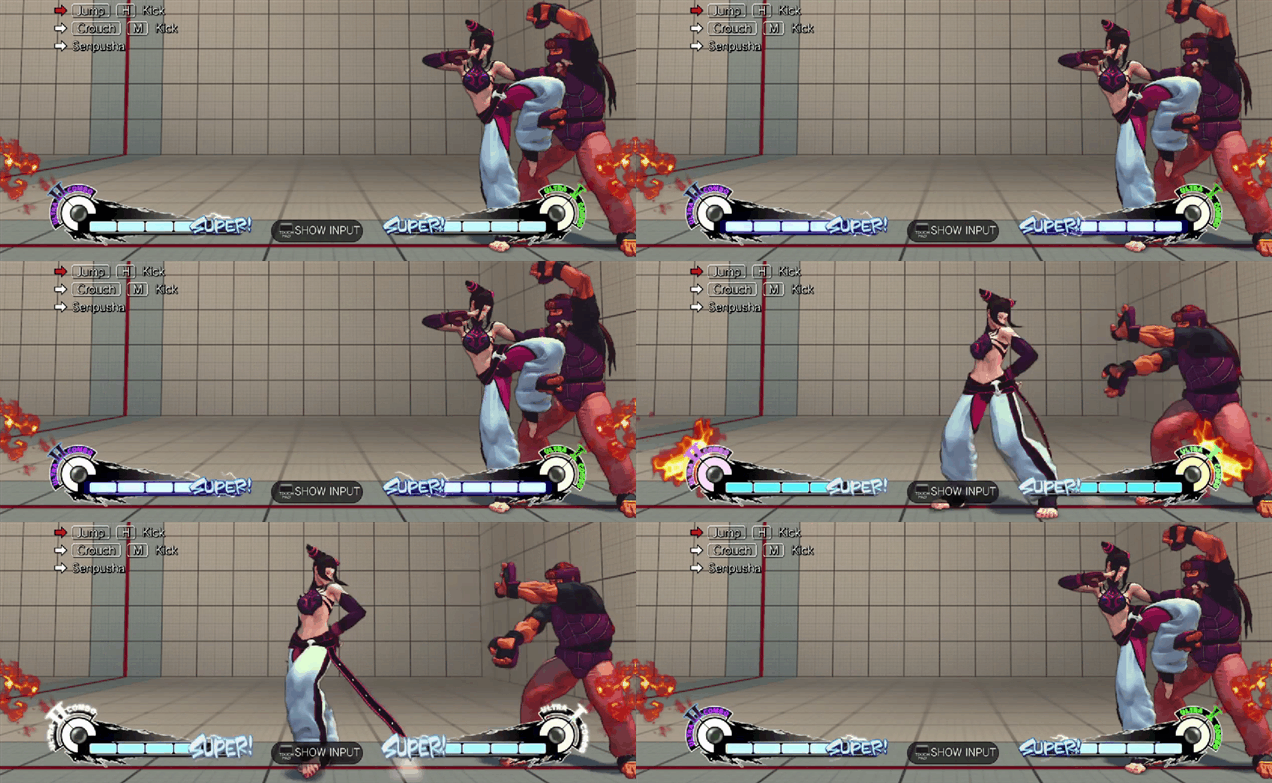
Ultra Street Fighter IVis kinda janky on PlayStation 4 . Which was making competitors nervous ahead of this year’s big EVO fighting game tournament, so instead of taking their chances with Sony’s promised fixes , organisers are taking a safer route with the game’s appearance, deciding instead to switch the platform it’s appearing on.
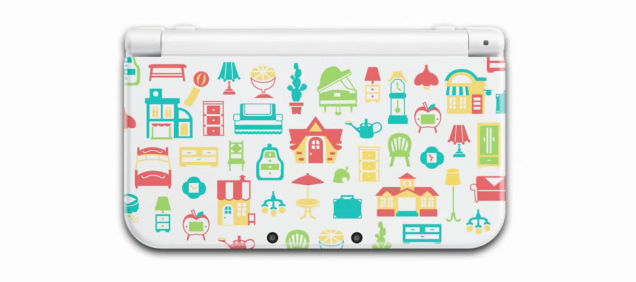
To this day, my favourite 3DS design is the Animal Crossing one . That place in my heart is being challenged today, however, by a new Animal Crossing 3DS design.