Life Is Strange Episode 2 will release on all platforms on March 24, developer Dontnod has announced.
Dontnod announced the release date at the EGX Rezzed convention in London, where it also played through 15 minutes of the new episode on stage.
You can watch the presentation and gameplay footage of the new episode in the archived Twitch stream embedded above, but if you care about spoilers, you’ll probably want to avoid it.
Episode 2 is coming out according the schedule, despite earlier reports that it might miss its original March release date.
Dontnod said that whereas the first was mostly an introduction to the game’s world and its characters, episode two will focus more on the consequences of your choices.
Life is Strange tells the story of Maxine Caufield, a senior photography student who discovers she can rewind time. The story is planned to unfold across five episodes, all released throughout 2015.
The South by Southwest (SXSW) festival is taking place in Austin, Texas this weekend, and last night it hosted the second annual SXSW Gaming Awards, where Dragon Age: Inquisition won another Game of the Year award.
Dragon Age: Inquisition previously won the Game of the Year Award at the Game Awards, and DICE 2015.
21 awards were given overall, and Middle-earth: Shadow of Mordor walked away with three of them. Monolith’s open-world action game won in the Excellence in Gameplay, Excellence in Animation, and Excellence in Design and Direction categories.
tinyBuild’s Speedrunners, a multiplayer racing and platforming game, won the Gamer’s Voice Award, which was chosen from the Indie Corner exclusively by gamers at the show.
Check out the complete list of winners below.
Game of the Year: Awarded to the indie or mainstream game that exemplifies gaming excellence.
Excellence in Musical Score: Awarded to the title that exemplifies artistic excellence in musical score, and how it is used to progress the narrative of a game
Excellence in Convergence: Awarded to the game that best exemplifies excellence in the crossover to other entertainment mediums such as film, music, toys, animation, sports and more
Most Valuable Character: Awarded to the best game character that left an overwhelming impression
WINNER: Ellie, The Last of Us: Left Behind – Sony Computer Entertainment/Naughty Dog
Most Valuable Esports Team: Awarded to the professional team that excelled in performance and provided the most valuable impact in its competitive scene(s)
Most Valuable Online Channel: Awarded to the gaming-related channel that consistently entertains and keeps us watching with its humor, stories, special effects and more
Most Valuable Add-On Content: Awarded to the best additional content or DLC that added even more value to a great game making the experience that much better
Most Anticipated Crowdfunded Game: Awarded to the most highly-anticipated crowdfunded game, through such platforms as Kickstarter, Early Access, Indiegogo, that lived up to expectations or has yet to grace our collections
Matthew Crump Cultural Innovation Award: Awarded to the title that most challenges the “norm” of everyday gaming, and offers a culturally innovative view of a game world, character or gameplay
Tom Clancy’s Rainbow Six Siege made an impressive debut at E3 last year, but we haven’t heard much about the game since. However, Ubisoft has announced that you might be able to play the game yourself soon in an upcoming Closed Alpha test.
Ubisoft didn’t say when it plan to launch the Closed Alpha, but you can register for it now.
You’ll need a Uplay account to participate, and can sign up through rainbow6.ubi.com. The Closed Alpha will be limited to PC players in North America and Europe only. You can find a map of eligible countries in this FAQ.
Ubisoft also shared the minimum system requirements you’ll need in order to participate in the Alpha. Keep in mind that Ubisoft is still working on optimizing the game, and that the launch specs will be lower than what you see here.
Siege was announced during E3 in 2014, though it’s not altogether a “new” game. It is the game that rose from the ashes of Rainbow Six Patriots, which Ubisoft effectively canceled. It plays a lot like Counter-Strike, with one team trying to save hostages from the enemy team. It made a great impression at E3 with its destructible environments, allowing players to shoot and blow up walls and floors to make their own path.
For more on the game, check out GameSpot’s previous coverage of Rainbow Six Siege.
Developer Tripwire Interactive has released a new developer diary video, which details Killing Floor 2‘s weapons and perks.
Tripwire president John Gibson explained that one feature unique to Killing Floor 2’s weapons are the reload animations. Whereas the average reload animation is 30 frames-per-second, Killing Floor 2’s reload animations are highly detailed 200 frames-per-second, which makes them look smooth when you activate the game’s special “Zed Time,” slow motion ability.
In Killing Floor 2, each perk you choose at the start of a game is paired with a starting primary weapon and a specialized grenade. For example, the commando will start with an AR-15 assault rifle, while the support classes will start with a shotgun.
For more on the game’s new weapons and perks, watch the video above.
Starting a month after the events of the first game, Killing Floor 2 takes place on continental Europe, where a virus that turns people into monsters has spread.
Battlefield Hardline‘s roster of vehicles is fairly different from that of past games, as is to be expected given this is cops-versus-robbers rather than a military-focused game. In addition to the police cruisers and other vehicles you can probably predict, Hardline also has a very strange vehicle for players to find: a sofa.
As discovered by YouTube channel Jackfrags, Hardline allows players to drive around on a couch called The American Dream. It allows for four players to jump on and ride around on what is reportedly the fastest vehicle in the game.
As with other vehicles, you can kill enemy players by running them over. The one difference is that, when you do so with the couch, the kill feed lists the killing weapon as “MERICA.”
The American Dream can be found in Hotwire mode on the Dust Bowl map. It spawns in one of several different locations, but only a single time per round–once it’s been destroyed, it’s gone until the next game begins. Fortunately, the repair tool can be used on the couch to help prevent that from happening.
There’s no word yet on whether any DLC will be released to deck out the couch.
Oculus founder and inventor of the Oculus Rift virtual reality headset Palmer Luckey previously said that something would have to go “horribly wrong” to prevent the device from an official launch in 2015. Three months into the year, we still don’t have a release date.
Did something go horribly wrong? Luckey answered the question while speaking at a SXSW panel.
“I did say that before we made a lot of changes to our roadmap and we’ve expanded a lot of the ambition we had around the product and what we wanted to do,” Luckey said. “Us partnering with Facebook allowed us a lot of things that we wouldn’t have been able to do otherwise like hire 300 people to be working on getting the Rift out as quickly as possible at the level we want it.
“I can’t comment on the date one way or another in either direction but I can say that nothing is going horribly wrong. Everything is going horribly right.”
Luckey commented on whether he feels more pressure to release the Oculus Rift now that Sony and Valve have announced that they will release their own virtual reality headsets in 2016 and 2015 respectively.
Luckey said that it doesn’t add more pressure because there “couldn’t possibly be more pressure anyway,” and that Oculus wants to launch the Rift as soon as possible, but without comprises.
“I do still think that it will be [the best VR headset at any price],” he said. “That could change because that means that there’s something even better out there, but I think that’s unlikely right now.”
You can watch the SXSW panel in the archived Twitch stream above.
This weekend, a number of Ubisoft’s PC games (and their respective DLC packs) have been steeply discounted on Steam, including many of the Assassin’s Creed and Far Cry games.
Assassin’s Creed Unity is $36, or you can get it as part of a bundle with the newly released PC version of Assassin’s Creed Rogue ($50 on its own) for $80.28. Black Flag is $20, while earlier games in the series can be had for about $5.
Far Cry 4 is $36, or it can be had in a bundle with all of the previous games in the series (including Blood Dragon) for $53.97.
Check out the full list of discounted games below. For a look at all of the bundles and DLC that are also included in the sale, which runs until March 16, head over to Steam. And for more great deals, check out GameSpot’s regular Gaming Deals posts.
From now through the end of the year, Pokemon Bank users can receive three very desirable Pokemon from HeartGold and SoulSilver for free.
Meganium, Typhlosion, and Feraligatr, the three final forms of the starters from HeartGold and SoulSilver (Chikorita, Cyndaquil, and Totodile), are now available free of charge through the Pokemon Bank. This means that, even without having played either of those games, you can bring all three of them into Pokemon X, Y, Omega Ruby, or Alpha Sapphire.
In order to get your hands on them, you simply need to access the Pokemon Bank from one of those four games between now and November 30, 2015. Once you’ve done that, you’ll access the Pokemon Link to download them.
All three come equipped with Hidden Abilities. Here’s what the Pokemon Company has to say about each:
Meganium’s Leaf Guard Hidden Ability protects the Pokémon from status conditions when sunlight is harsh or extremely harsh. Plus, this Meganium knows the move Sunny Day, allowing it to take advantage of its own Ability!
Typhlosion has the Flash Fire Hidden Ability, which powers up Fire-type moves by 50% and prevents this Pokémon from taking damage from Fire-type moves. With three strong Fire-type moves already in its arsenal, Typhlosion can make the most of Flash Fire in battle.
Feraligatr’s Sheer Force Hidden Ability eliminates the additional effects of this Pokémon’s attacks, but they will do an additional 30% damage instead. This Feraligatr knows three moves that have additional effects: Ice Punch, Crunch, and Waterfall. They won’t cause their additional effect, but they’ll all do huge damage!
Pokemon Bank launched last year as a way to help facilitate the transfer of Pokemon from game to game. You can store up to 3,000 Pokemon for a fee of $5 per year.
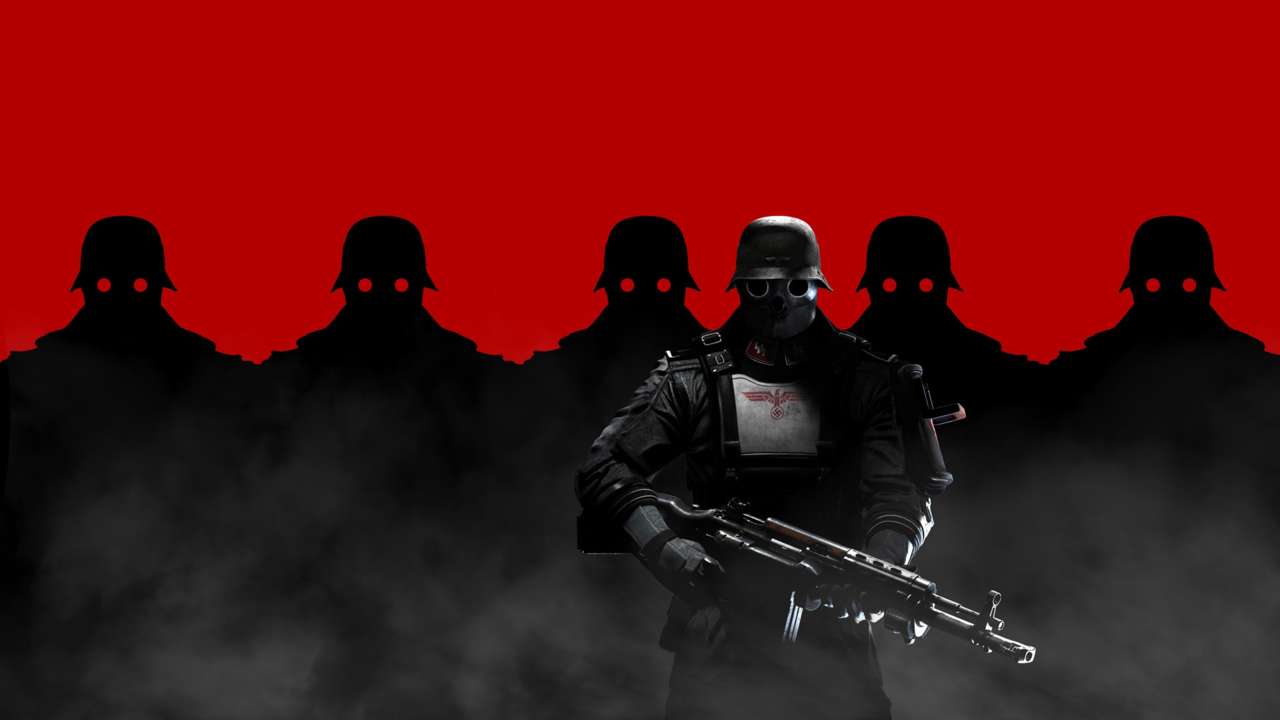
Amazon has the best new deal of the day, offering Wolfenstein: The New Order for $23 on the PlayStation 4 and $24 on Xbox One. It’s a great opportunity to pick up on the game and catch up before the release of the standalone expansion, Wolfenstein: The Old Blood.
Below you’ll find the rest of today’s best deals divided by platform:
Amazon prices are accurate as of publishing, but can fluctuate occasionally throughout the day.
GameSpot’s gaming deals posts always highlight the best deals we can find regardless of retailer. We also occasionally use retailer affiliate links, which means that purchasing goods through those links helps support all the great content (including the deals posts) you find for free here on the site. Got questions? Email news@gamespot.com or ask us in the comments!
I can’t avoid fate. I have turned down opportunities to play Bloodborne multiple times and have averted my eyes when I saw videos and articles on From Software’s upcoming role-playing adventure. It springs from a structure introduced by Demon’s Souls, and arguably perfected by Dark Souls, the game that proudly stands as my favorite of its console generation. I write this after returning from a visit to PlayStation headquarters just outside of San Francisco, where I clouded my previously clear eyes with the entrails of Bloodborne’s fantastical creatures. Soon enough, I will be in possession of the full game. And now I understand that I must unlearn some of the lessons Dark Souls taught me before I thrust myself into this difficult journey.
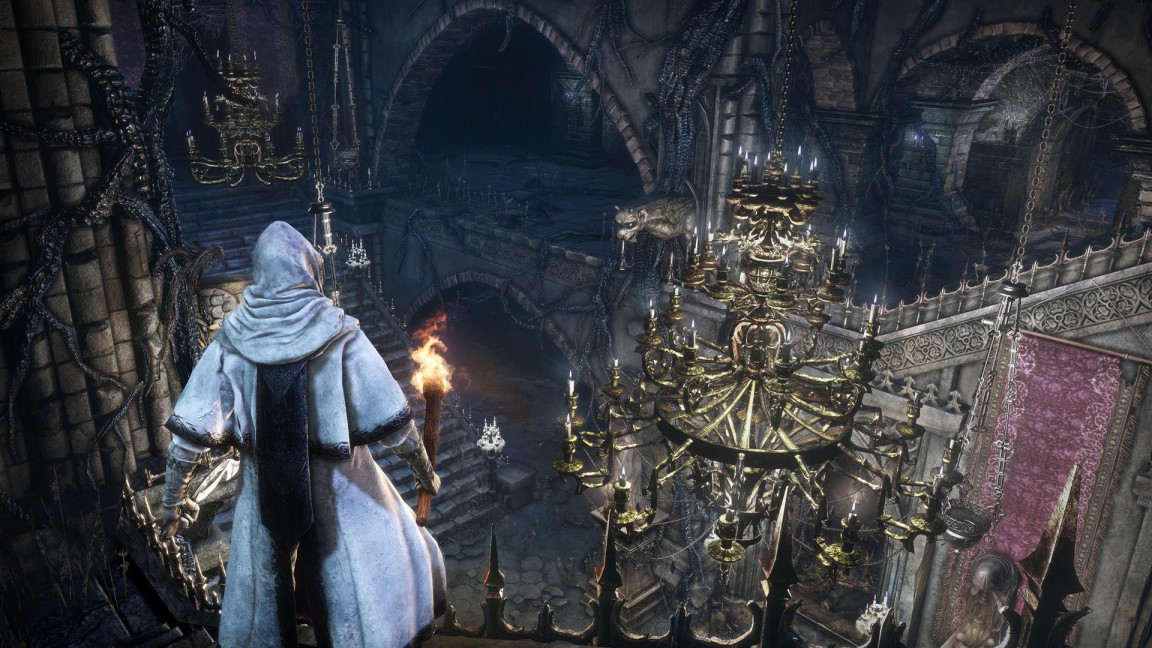
The span I played took me through a chalice dungeon–that is, an optional dungeon you enter by performing a particular ritual with a chalice, and which can be conquered on your own or with others. Some of these dungeons will be procedurally generated, snapping modules together into exploration spaces that house great danger. The dungeon I entered was wholly designed, however, leading me into its depths one level at a time, and gating my progress behind doors that required me to pull levers elsewhere in the area to open, and behind grotesque bosses that had me yelling out in terror, much to the chagrin/delight of the Sony representatives viewing my play session.
My usual reliance on brawn and bulk was the first Souls game inclination I had to unlearn. Flailing mutants and diseased rats needed to be vanquished, but there was no shield to hide behind. Instead, I wielded weapons in both hands, and could easily switch between two right-handed blades with the press of a button. In my left hand was a shotgun, which could do some damage from a moderate distance, but which (of course) provided more offensive power up close. I could also hold a torch aloft in place of my gun, which was a boon when the corridors darkened. (If you are worried that Bloodborne would make torches as pointless as they were in Dark Souls II’s original release, you can rest your mind in that regard.) However, it was the blades, in tandem with my firearm, that saw the most onscreen action.
With this setup, there was no chance to absorb the damage and counter with my own weighty blows. I had to stay on the move, not blocking, but tumbling in whichever direction would best help me avoid damage. But take damage I most certainly did, and while I had a plentiful supply of health potions to quaff, it is by doing damage that I was able to in turn mitigate the damage done to me. Once you take a hit, you have time to regain lost health by landing attacks against your attackers. This mechanic encourages aggressive, mobile play, and while I don’t know that I ever fully came to grips with the combat’s rhythms, I was soon able to put aside my usual Souls game tactics and embrace a new way to do battle.
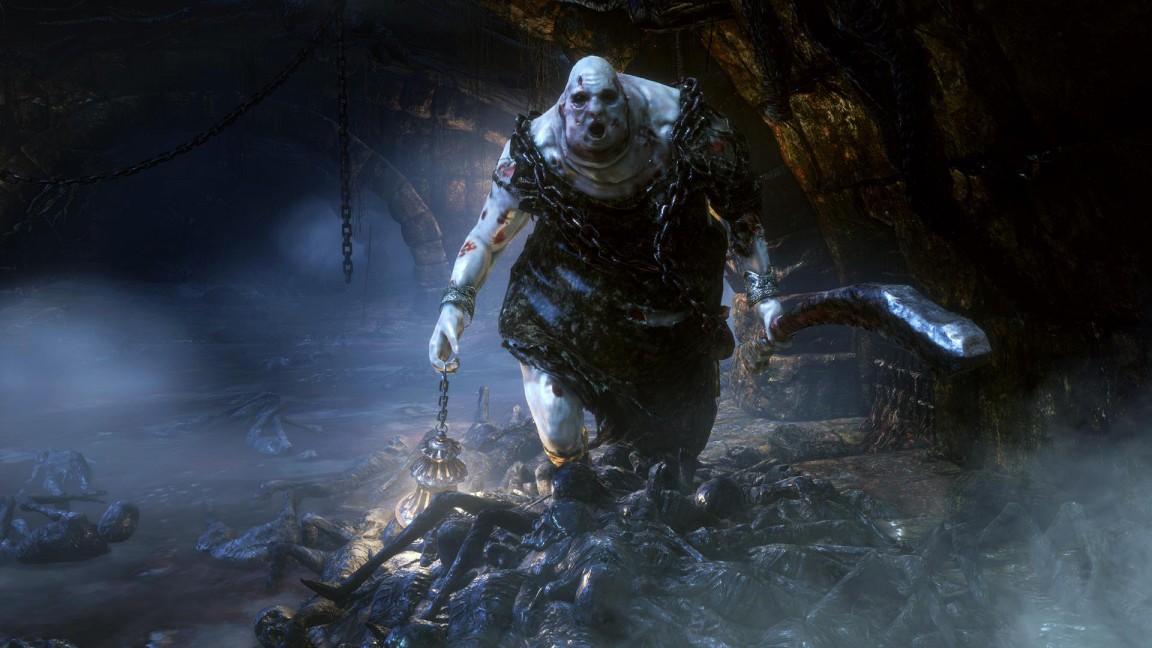
This isn’t to say that I still didn’t proceed carefully. Some of the enemies are even more mobile than you are, and charge forward with gusto. One such foe was a fat demon I expected would stop, drop, and roll in the manner of his Dark Souls II cousins. Well, he performed that move, all right–in addition to a dash so quick that I could barely get my bearings. Ammo isn’t infinite, so offing him with a few careful shots wasn’t an option, and I had already used up the molotov cocktails I started with. I died. It wasn’t the first time I’d perished during the demo, but it was the first encounter that had me crying out a particular four-letter word that would make my mother blush.
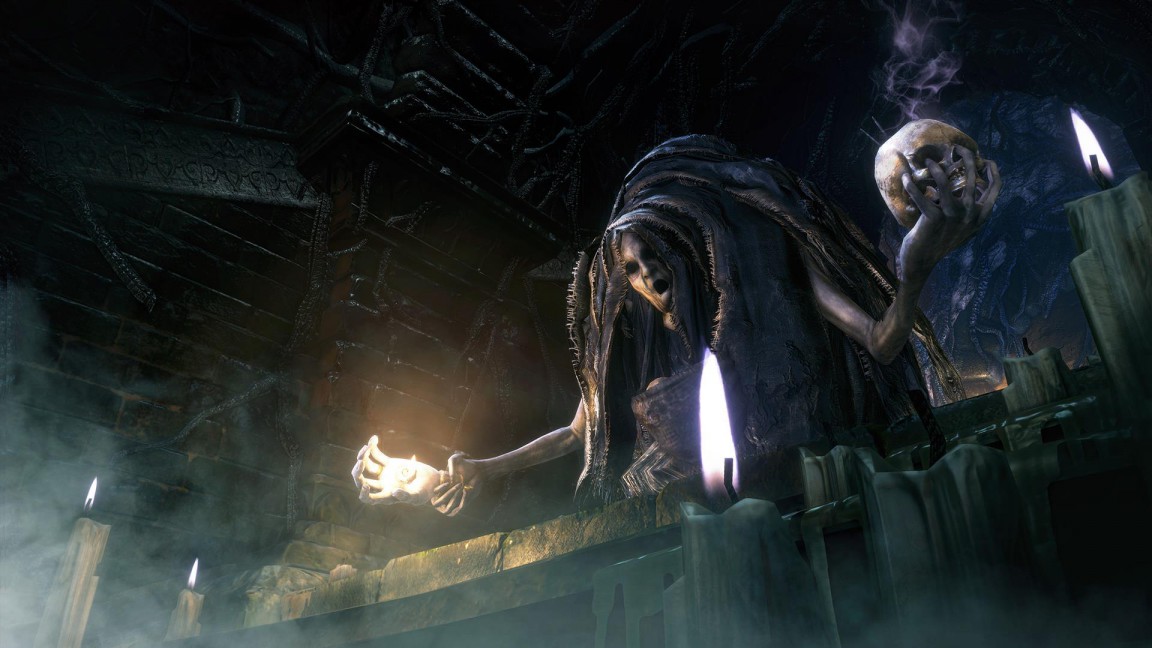
I’d been shouting out other curses, though, even in the first, relatively simple area, where both Demon’s Souls and Dark Souls were each represented in their own ways. In one area, I had to cross a narrow bridge above which giant axes swung. I was taken back to Dark Souls’ Sen’s Fortress, though my greatest nemesis here wasn’t a swinging axe, but instead the lanky demon that flung a dart into me, which in turn sent me reeling–once into the axes, and once off the bridge completely. (Down below, I was monster meat in about half a second.) Demon’s Souls came to mind when I encountered bell-ringing witches, though thankfully, they were not mind flayers. Instead, they continuously summoned more gangly demons from the bowels of hell until I destroyed them.
Three bosses stood between me and final conquest. The first was the kind of gargantuan flesh demon I’d come to expect from Souls games, and it didn’t take too much effort to end its existence with some well-timed dodges and swings. The second and third encounters were standouts, however. The second boss encounter set me against three rotund attackers at once, one of which had his own firearm at hand. Luckily, the three-tiered arena allowed me to separate them by leading them up and down opposite sets of stairs, and while it took me a couple of tries, I had soon defeated two of them, leaving the shotgunner for last. To annihilate him, I hid behind a pillar and popped out to slash away before tumbling back to safety. Eventually, he ran out of ammo, and chased me around with a giant club until I sent him back to whatever circle of hell he came from.
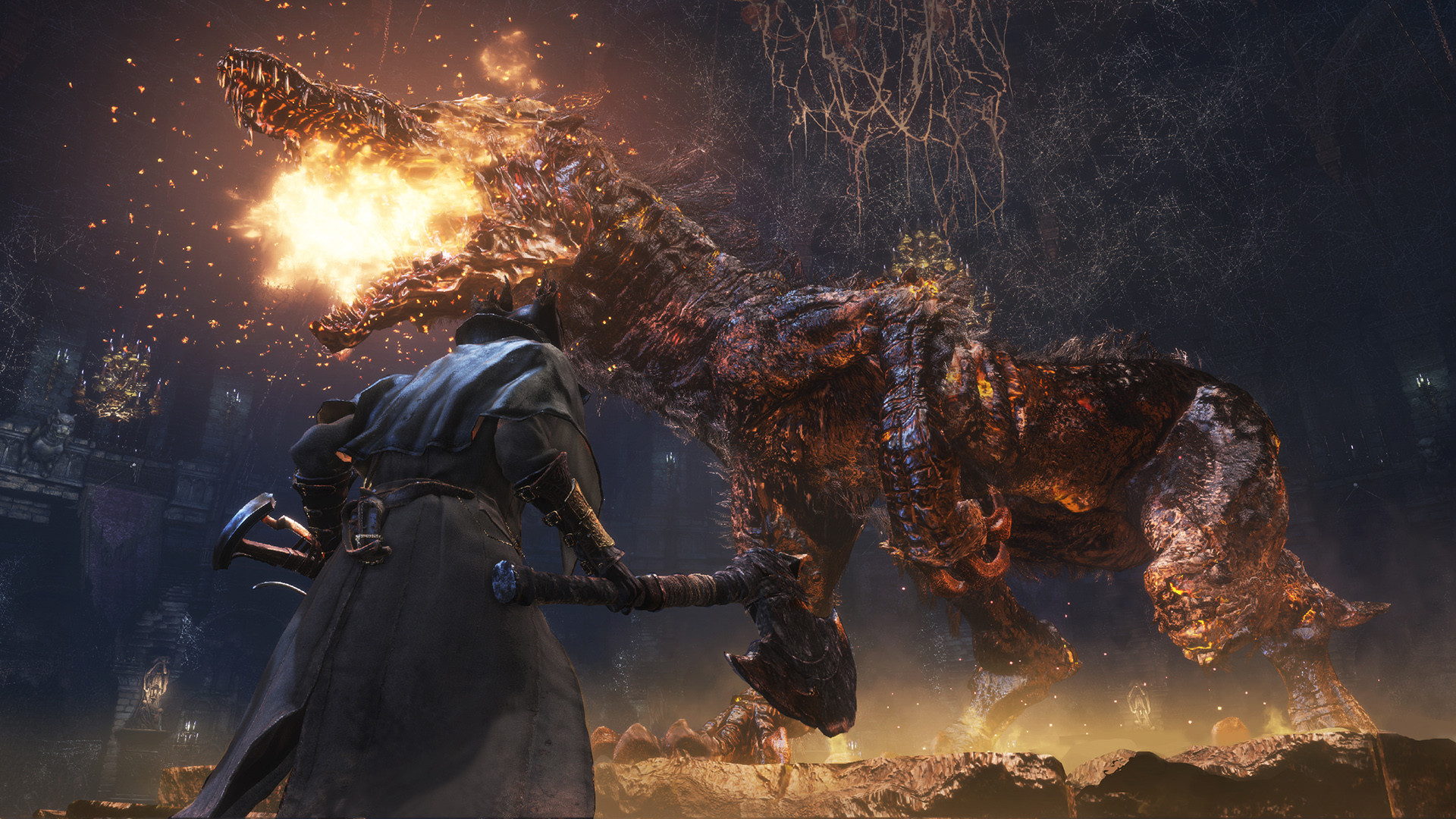
The final boss was an ancient guard dog, a flaming pup who found all number of ways to burn me to a crisp. It was here that I really began to appreciate how well Bloodborne’s combat arenas supported its fundamentally agile gameplay systems. The canine could spread bubbling lava from its mouth, and while there was plenty of room to steer clear, the dog could cover a lot of distance very quickly, which in turn could send me rolling into lava when I tried to avoid it. I also came to appreciate the game’s fluid weapon-switching: when he would swing his head towards me, I could get in a swing of my longer, heavier cleaver, while my smaller blade was most helpful when he paused to coat the ground with fire, and I could swing multiple times before dashing to safety.
It was a tense and eerie gameplay session, with each new enemy crushing my soul as I gripped the controller. One creature–a looming skeletal arthropod–looked like an ancient fossil come to life, and several of them lobbed balls of fire towards me. It was a phenomenal sight and a challenging area, given that I had to deal with bell-ringers and other adversaries in addition to the fireball-spewing freaks. But once I learned to close the distance and flail away on the skittering things’ tails, they weren’t long for this world. And so it will go in the full game, I imagine: moving through the darkness and fog, and discovering new ways to destroy whatever gross brute stands in your path. We’ll know soon enough–and I am already stocking up on anti-anxiety medicine in anticipation.