Blog
-
Lord of the Rings: War in the North – Official Weapons Trailer

This trailer shows the variety of weapons available in Lord of the Rings: War in the North. See what our heroes use to fight in the new LOTR video game.
-
Pong – Arcade Pong
Nolan Bushnell’s first exposure to video games was a game called “Spacewar.” Programmed by an MIT student named Steve Russell in the early sixties, this game has circulated computer labs across the country by the time Bushnell would play it in a lab at the University of Utah in 1962. He would spend the next seven years of his life trying to reproduce that game on a smaller, less expensive computer. When it was completed, Bushnell’s Spacewar variation (known as “Computer Space”) did not sell. Frustrated by this, Bushnell changed his entire perspective on computer game design.
In an interview, Bushnell later said, “You had to read the instructions before you could play, people didn’t want to read instructions. To be successful, I had to come up with a game people already knew how to play; something so simple that any drunk in any bar could play.”
In 1972, Bushnell quit his job at Ampex in Sunnyvale, California, and with two other former Ampex engineers started his company. Originally, the three applied for the company name “Syzygy,” but that had already been taken by a roofing firm. Bushnell enjoyed playing the Japanese game “go” and his next suggestion was “atari” which means “check.” This name was accepted by theCalifornia Secretary of State, and on June 27, 1972, Atari was officially established.
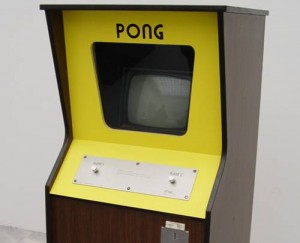
Al Alcorn, one of Atari’s first employees, was the engineer who constructed the first Pong arcade game. The game was named after the desired sound that Bushnell wanted incorporated in the game. The dictionary defines “pong” as a hollow, ringing sound, and this was the sound Bushnell felt was necessary in the game.
The first Pong arcade machine was placed in a local bar in Sunnyvale called Andy Capp’s. It was more of a trial than anything else, as the unit did not even have a fully constructed case. The following is an account of the first night Pong was in this bar, reproduced from “Zap! The Rise and Fall of Atari” by Cohen.
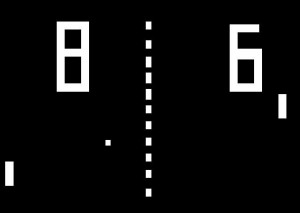
“One of the regulars approached the Pong game inquisitively and studied the ball bouncing silently around the screen as if in a vacuum. A friend joined him. The instructions said: ‘Avoid missing ball for high score.’ One of [them] inserted a quarter. There was a beep. The game had begun. They watched dumbfoundedly as the ball appeared alternately on one side of the screen and then disappeared on the other. Each time it did the score changed. The score was tied at 3-3 when one player tried the knob controlling the paddle at his end of the screen. The score was 5-4, his favor, when his paddle made contact with the ball. There was a beautifully resonant “pong” sound, and the ball bounced back to the other side of the screen. 6-4. At 8-4 the second player figured out how to use his paddle. They had their first brief volley just before the score was 11-5 and the game was over.
“Seven quarters later they were having extended volleys, and the constant pong noise was attracting the curiosity of others at the bar. Before closing, everybody in the bar had played the game. The next day people were lined up outside Andy Capp’s at 10 A.M. to play Pong. Around ten o’clock that night, the game suddenly died.”
The reason for this was that the milk carton coin container inside the machine was overflowing into the electronics. After it was emptied, the game continued its usual operation.
Pong would become a huge hit in the arcades, spawning numerous imitations and several official sequels. Its popularity would not die down, until it was replaced by more advanced systems that used microprocessors instead of LSI (Large Scale Integrated) circuits.

-
Top 10 Shameless Licensed Games
We count down the ten most dangerously cheesy advertisements in video game form!
-
DIABLO 3 BETA ANNOUNCED !!!!!
The Diablo 3 beta goal dates were announced today as being somewhere between July 1st and September 30th, 2011!!!!
-
L.A. Noire Launch Trailer
From the creators of Grand Theft Auto and Red Dead Redemption comes a film noir-style cop drama set in 1940s Los Angeles. The wait is almost over! See more in-game footage in the Launch Trailer of Rockstar Games’ L.A. Noire.
-
Magnavox Odyssey

Magnavox Odyssey
After the rejection by the military of Raplh Baer’s idea, Baer would spend several years covertly trying to obtain the legal rights to commercially reproduce the game machine he helped design at Sanders Associates in 1966.Eventually the Pentagon became disinterested in the “TV Game” project, and Baer was allowed to pursue the prospect openly. He approached Teleprompter, RCA, Zenith, General Electric, and Magnavox. A deal was struck with RCA, but later fell through because it involved the purchasing of Sanders Associates by RCA. Then in 1970 Bill Enders, who had been a part of the RCA negotiating team, joined Magnavox and persuaded the Magnavox executives to give Baer’s system a chance. The result of this was the production of the Magnavox Odyssey, the first home video game system available to non-military personnel.
The Odyssey had over three hundred seperate parts. It came with hand controls, dice, playing cards, and play money. Plastic overlays which were placed onto the screen by the consumer, provided color playing fields for the various games. The system came preprogrammed with twelve games that utilized all of the aforementioned equipment.
While it could not compete with the Pong units that would be released soon after, the Odyssey did have a very impressive first year, selling over 100,000 units at $100 each.
The real cause for the popularity of the Pong units over the Odyssey was not because of the marketing prowess of competing companies, but rather the creation of low cost LSI (Large Scale Integrated) circuits. These circuits were designed primarily for tennis, hockey, and other Pong-eqsue game mechanics. The low cost LSI’s would allow the market to be flooded by Pong knock-offs.