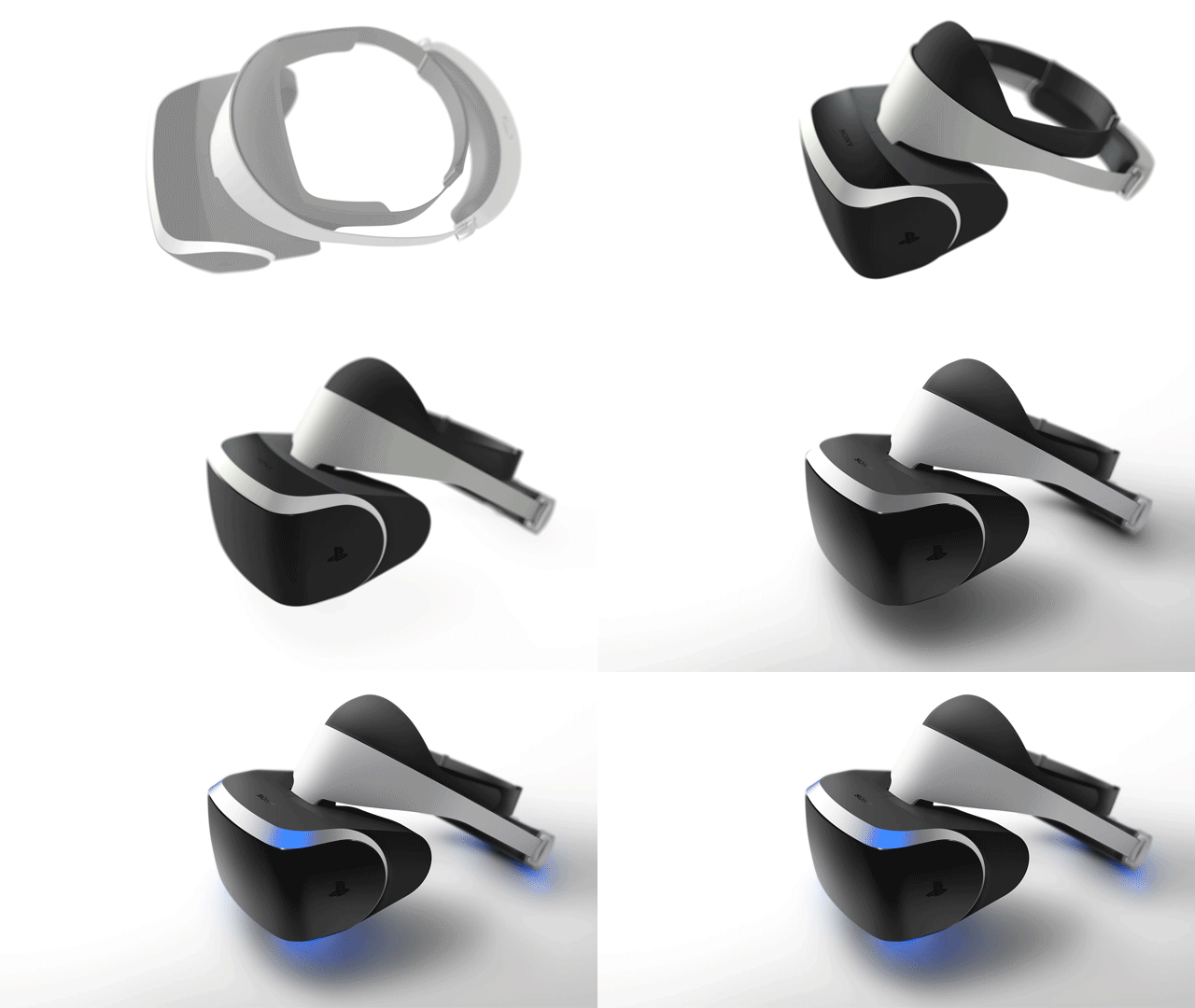
A couple of days ago, I felt like I was standing in a shark tank. Some time before that, Sony’s head of PlayStation game development, Shuhei Yoshida, fed a dinosaur and the company’s top PlayStation researcher, Richard Marks, stood next to the Mars rover—all in virtual reality, of course. With any luck, you will eventually be able to as well.
From the desk of Ryu Hayabusa: “Why won’t he let me save the world? I just want to help people. And hug animals. And give lavender lollipops to children and old people. Mmm…Momiji’s thighs. No, I have to save the world. Where’s my binkie?”
From the desk of Momiji: “He’s got some hot woman helping him. I’m sooo jealous. Maybe I’ll kill her when I see her. Or maybe we can make out. Maybe we’ll have a threesome! I’ll do whatever Yaiba tells me to do. I’m so horny…”
These diary entries weren’t actually written by the attributed authors, but rather rose from the vivid imagination of Yaiba: Ninja Gaiden Z’s antihero. And they tell you much of what you need to know about this hack-and-slash game’s unlikable star, as well as its own sense of humor. Ninja Gaiden Z is crass and stupid but rarely funny. It’s mean and dumb but never witty or subversive. Listening to its characters speak is like hearing the inner workings of an 8-year-old’s mind–an 8-year-old who just discovered how to swear and can’t wait to drop his newfound knowledge at dinnertime. Puerile profanity and sexual humor can be appealing, and games like South Park: The Stick of Truth and MadWorld revel in their own lewdness to great success. By contrast, Ninja Gaiden Z flings swearwords and bawdy imagery and wants you to laugh because, you know, vaginas are funny.
Player character Yaiba is clearly not meant to be liked as he pursues his revenge quest against archnemesis and usual Ninja Gaiden star Ryu Hayabusa, but then again, no one comes across as particularly interesting or charismatic–not one-note guide Miss Monday, whose primary character traits are her monumental breasts, and certainly not the composers of the game’s compendium. Complaining of his wealthy boss, one author writes, “After six years of holding our dicks in our hands, finally that Spanish knobhead Del Gonzo authorized some action,” and later enthuses over his rising “blood-boner.” The alluring comic-book art style and initial gore are enough to inspire a momentary blood-boner, but sadly, the poor dialogue is not the game’s biggest deficiency.
No, that honor belongs to the action itself, which furnishes just enough fun to make you wonder how developers Comcept and Spark Unlimited allowed it to go off the rails so often. As cyberninja Yaiba Kamikaze, you wade through cartoon zombie hordes using your sword, your flail, your metal fist, and every so often, a weapon that downed foes drop, like electrified nunchuks or a rocket launcher. When encounters are kept simple, the action is immensely shallow, but satisfying in a button-mashy kind of way, in which you press buttons and blood splatters all over your television screen.
You’ll fight this big boy a half-dozen more times than you’d want.
My favorite standard weapon is the flail; using it gives the combat a God of War feel, and its long reach makes it useful for ripping through a large number of lurching zombies at once. The flail’s appeal is not found just in its ability to create copious amounts of blood, but also in its mass trauma capabilities, allowing you to make numerous foes simultaneously vulnerable to a gory execution. Such executions can be chained together in quick succession, with you pulling a shoulder button when one execution pauses to move on to another. Not only is there some innate glee in seeing zombie heads fly into the air and undead bodies split in half at the torso, but performing executions rewards you with refreshing red cubes that replenish your health meter.
As much as Yaiba’s flail recalls Kratos’ blades of chaos, Ninja Gaiden Z more resembles 2010’s Splatterhouse, not just in its cel-shaded look and sneering tone, but also in its absurd defects, which squash the fun and replace it with equal amounts of tedium and frustration. The irritations don’t arise from one design element, but from a mass of them that make Ninja Gaiden Z feel less like a cohesive action game with a clear rhythm and flow, and more like a series of disconnected concepts that don’t make any sense together.
Ninja Gaiden Z is crass and stupid but rarely funny. It’s mean and dumb but never witty or subversive.
Many of these elements are fundamental, and thus substantial, even when they seem initially minor. The fixed camera is a frequent problem, sometimes forcing you to traverse areas and fight off unseeable enemies without giving you a proper view of your surroundings, and other times swooping around when you cross a threshold in the midst of combat, disrupting the tempo of combat as well as the viewable arc of the combat arena. It’s even less fun when you begin one of many battles against a mechanical boss, in which its hulking metal body looms in the foreground, and you dash around behind it, hidden from view. You might even try dashing between its thundering legs, only to get caught up on an invisible collision box and be forced to take your lumps as you try to extricate your bruised body.
As if to mimic Ninja Gaiden’s famously high level of difficulty, Ninja Gaiden Z fills the screen with hulks that fling fire, jilted brides that sizzle with electricity, and mutants that puke bile in your direction. But where games like Ninja Gaiden Black gift you with precise combat systems that reward skillful play, Ninja Gaiden Z takes the shallowest and cheapest approach to difficulty imaginable, throwing so many of these enemies into the arena that skill is barely relevant. Sparking enemies teleport to your side and slap you around while you’re dashing about to snuff out the flames engulfing you; killer clowns knock you into submission when you’re rushing away from suicidal grenadiers. Blocking and countering certain attacks is possible, but is rarely a viable tactic given how quickly and randomly this mess plays out onscreen.
Time to stop clowning around, Yaiba.
Ninja Gaiden Z’s so-called chemistry set exacerbates the frustration. When certain elements come in contact with each other–the biological spew of a blister sister and the flames of a holy roaster, for instance–they cause interactions. The chemistry set is functional enough when you use it to solve the game’s mild puzzles, but the lightning storms that suddenly ignite on the battlefield when fire and lightning meet are more hazardous than the threats they alleviate. As a result, death is a frustration and not a teaching tool, and your primary method of healing–collecting post-execution health drops–is unreliable. The prompts to execute enemies might appear in the middle of one sword swing and vanish just as quickly when the second half of your combo rips the vulnerable enemy to shreds.
Gross!
This is one of many examples of how Ninja Gaiden Z corrupts its most interesting mechanics with subpar detailing. Executions satisfy the primal urge to squish mutated baddies, but they’re also gawky to watch, given how each chained execution is visually distinct rather than connected to the others. Performing a series of brutalities is more like viewing a series of incoherent three-second films than showing off your acrobatic expertise. Another of Ninja Gaiden Z’s best assets–its scripted, high-flying parkour sequences–are similarly diminished. Stringing leaps, grapples, and punches like the world’s most violent gymnast is an absolute blast; fumbling around with the finicky contextual jumps (indicated by a ledge splattered with blood) and camera angles that disrupt your sense of depth is not.
So much for that blood-boner, then, not that you’d be able to keep it up during the game’s first major showdown, which drops to single-digit frame rates in the heat of battle. Still, Yaiba: Ninja Gaiden Z keeps pumping out the blood, hoping to turn you on with its gory combat and vulgar attitude. Every so often, 8-year-old me–the part of me that thinks that asking everyone what word starts with “f” and ends in “u-c-k” is funny–got a kick out of Yaiba’s exploits. Most of the time, however, I could only wish that Ninja Gaiden Z’s striking art style had been applied to a better canvas.
Experience all the Fun, Excitement, and Drama of Football’s Greatest Event. Multiple improvements and innovations to the award-winning gameplay of FIFA 14, plus 100 new animations, make EA SPORTS 2014 FIFA World Cup Brazil the most accessible, fun, and exciting EA SPORTS FIFA title on Xbox 360 and PlayStation 3.
Bring to life the world’s greatest tournament by choosing from 203 National Teams in the deepest set of modes ever in a tournament title from EA SPORTS. Immerse yourself in the FIFA World Cup as you play in authentic Brazilian stadiums, and recognize the support of newly rendered crowds created to replicate the passion and pageantry of the 2014 FIFA World Cup Brazil.
EA Sports 2014 FIFA World Cup Brazil gives you the opportunity to play in one of the worlds most popular and exciting sporting events. Football, also known as soccer in some countries, offers lots of fun for players of all ages. Now you can become a part of the FIFA World Cup as you compete in this tournament against teams from all around the world. Players are able to choose from 203 National Football teams who they would like to compete as. Become the captain of your countries team and organize the squad list to your liking to create the best team possible. In this thrilling game, players will take their team through qualifying rounds all the way to the FIFA World Cup finals. Progress across the map as you play football games in 12 cities throughout Brazil, finally leading to the final held at Estadio do Maracana in Rio de Janeiro. With real scenarios from these football events, you are able to recreate the outcomes of some of the most popular football game matches in history.
Metal Gear Solid’s hallmarks have never been represented better than in Ground Zeroes, the prologue chapter to Metal Gear Solid V: The Phantom Pain. It combines tense stealth and best-in-class cutscene direction, and these aspects stand above any other game in the series, but naturally, the narrative ultimately concludes sooner than you’d like. It may only take you an hour or two to finish the main objective, but the game doesn’t totally end there. In addition to filling in some of the gaps between Metal Gear Solid: Peace Walker and the Phantom Pain, Ground Zeroes introduces a new stealth system and an open-world format that’s perfect for experimentation. Even though you’re prepared for the next chapter, what’s the rush? After the credits roll on the main mission and a handful of side activities unlock, the best part of Ground Zeroes is just getting started. With a wealth of secrets to find, and new challenges to master, chasing the endgame will keep you entertained for hours on end.
The story sequences in Ground Zeroes captivate with impressive cinematography, properly showcasing the exploits of the brutal yet heroic Big Boss; a battlefield prodigy who long ago disavowed his allegiance to the US Government and established his own military for hire. Metal Gear has always been recognized for having impressive cutscenes, but they’re usually hindered by inconsistent animation and over-the-top voice acting. Thankfully, the opposite is true in Ground Zeroes. Characters move and speak with a natural grace, and even though it’s jarring to hear the recognizable Kiefer Sutherland voice Big Boss in place of fan-favorite David Hayter, his delivery is far more realistic and believable. No matter the platform you play it on, you’re treated to impressive lighting and masterfully crafted character and environment models that, along with the renewed cast, elevate Ground Zeroes’ cutscenes above and beyond those from the past. They may not stick around for long, but they certainly leave a lasting impression.
Your mission begins in a typically dramatic fashion on a dark and stormy night at Camp Omega–a military black site on the coast of Cuba. You need to infiltrate the heavily guarded base to rescue a member of your entourage, and with only a shred of evidence to point you in the right direction, you have to use your powers of observation, eavesdropping, and some light interrogation to succeed.
Big Boss doing what he does best.
With Ground Zeroes’ minimal HUD, a narrow third-person camera angle, and a sprawling base filled with potential threats , sneaking behind enemy lines has rarely felt so tense and immersive. Metal Gear famously stars characters with exceptional sneaking skills, but they also come equipped with fantastical gadgets that make their jobs easier by revealing enemy locations and alert states. Unlike in older games, there’s no automated radar to track nearby enemies in Ground Zeroes; the only way to track enemies is to first spot them with your own eyes, and only then, after marking them with your binoculars, can you follow their movements. Knowing where any of the dozens of enemies are yields a small amount of confidence, but it’s a minor consolation when every corner you turn may present unpredictable challenges.
Sticking to the shadows, crouch-walking behind objects, or crawling through the grass keeps you out of sight in most cases, but should an enemy catch a glimpse of Big Boss, you have a brief opportunity to redeem yourself when he enters reflex state. This bullet-time-like slow-motion effect gives you a few seconds to disable your spotter with short-range melee attacks or a well-placed shot to the head in order to avoid triggering a base-wide alert. Does it give you an unfair advantage over your enemies? Of course, but like the marking system, it also makes the transition into immersive, open-world stealth a little easier to swallow.
A Snake’s eye view of Camp Omega.
Unless you’re a naturally gifted expert, it’s a given that you’ll eventually be spotted. Immediately, alarms blare, and enemies, sometimes in armored vehicles, flock to your last known location. You have two options: face them head-on or flee and wait for them to give up their search. It’s not a binary system, however, and even though you may have lost your pursuers, they can remain on high alert for some time. In the past, a handy icon and a countdown timer would help you determine where your enemies were and how long you had to remain in hiding before they gave up. Those features have been removed, so you have to monitor live radio communications to gather the same intel.
The need to pay attention to your in-ear radio–which can sound off at any time–and the removal of automated radar systems set Ground Zeroes apart from the rest of the series. Nothing is simply handed to you, and Ground Zeroes is a far more tense and rewarding experience for it. Even though marking enemies and having reflex at your disposal are helpful, you have to work to use them to your advantage. If you want to immerse yourself in the game even further, you can disable marking and reflex altogether for the ultimate challenge.
After the credits roll and a handful of side missions unlock, the best part of Ground Zeroes is just getting started.
How well you manage to complete your objectives determines the ranking you earn at the end of a mission, and everything, from the number of times you’re spotted to the number of casualties you cause along the way, has an effect on your score and the rewards you earn. Such rewards include weapon drops at the start of missions and in-mission trials that can significantly alter your trajectory during repeat playthroughs.
Rankings aside, you don’t need to sneak in the shadows if you don’t want to, and with an entire military base’s worth of toys at your disposal, sometimes it’s fun to stand tall and announce your presence. Armed with C4 and RPGs, you’re fully prepared to blow up vehicles, destroy watchtowers, and charge in, guns blazing, when the mood strikes you. Though you’re encouraged to play into the game’s stealthy trappings by your co-commander, there are plenty of ways to actively disrupt Camp Omega, and some side missions are designed with this sentiment in mind. In one, you’re challenged to assassinate notorious war criminals, and another sees you firing explosives out of a helicopter to protect the extraction of a comrade.
Camp Omega is rife with explosive opportunities.
This dichotomy between stealth- and action-oriented gameplay lends itself to fear, tension, and excitement. One moment you can hear a pin drop, and the next, you’re bolting across a chaotic military base with bullets whizzing by your head and desperation clouding your focus. If this were a more linear experience, perhaps the allure of this contrast would wear thin, but there are so many ways to tackle individual missions, be it the path you take or the weaponry you choose, that there’s almost never a shortage of new tactics to explore. When your only playground is a military base, it’s easy to find new ways to entertain yourself in Ground Zeroes.
Unfortunately, if you hope to be entertained by an equal helping of Metal Gear’s typically perplexing and intriguing narrative, you’ll most certainly be disappointed. There’s some fat to savor here, hints of what’s to come in the next chapter of Metal Gear Solid V, but once you’ve digested the cutscenes that bookend the main mission, it’s a pure gameplay-driven experience from then on out. Though it’s unusual for everything to take place in a single location, there’s so much to do and see, and whether you take a stealthy or head-on approach, infiltrating Camp Omega is a thrilling experience that shouldn’t be missed.
Dragon Ball is one of those properties that’s had its ups and downs when it comes to game adaptations. And when I say downs, I’m talking about pretty incredible lows: bottom-of-the-barrel material like Ultimate Battle 22 and Final Bout that frequently turns up on “worst games ever” lists. But it’s had some highlights, too: The Budokai series made a lot of fans happy, hitting on a formula that satisfied what buyers crave from an anime-flavored fighter: a comprehensive cast, true-to-the-source visuals, and fighting that made you feel like a hyper-powered Super Saiyan.
Sadly, Dragon Ball Z: Battle of Z is not Budokai, instead following in the underwhelming footsteps of more recent DBZ efforts like DBZ Kinect. It’s a confused, overly chaotic mission-based action game that tries to recreate the team-based camaraderie oft seen in its source material, but more often than not falls flat on its face.
“You wouldn’t believe it! It was thiiiiiiiiis big!”
Battle of Z offers three gameplay modes: a single-player, mission-based story mode that follows the various story arcs seen in the anime/manga series, a co-op multiplayer mode, and a versus mode. The multiplayer modes become available after playing a short ways into the single-player mode, but you’ll probably want to play through a good amount of single-player to unlock characters, items, and status-augmenting cards you can equip on your Z fighters before going online. I say “going online” because there is no local multiplayer available: if you want to play with friends, you must play online.
You’ll jump into single-player mode first–since you don’t really have much choice. Once you navigate through confusingly-designed menus and get into the actual game, you immediately notice that while the character models themselves look fantastic, the environments are sparse and dull. To be fair, the anime wasn’t exactly known for its lushly illustrated backdrops, but the fighting arenas in Battle of Z rarely go past the likes of “craggy, rock-laden environment” on the inspiration scale. You’ll also likely struggle with the controls, which map everything to buttons that don’t really make a lot of sense (such as ascending and descending via the face buttons), and have you executing special skills with further badly-thought-out button combinations.
Once you achieve some measure of competency with the controls, however, you start to see the way combat flows in the game. You and a posse of pals (either human or AI-controlled) zip around arenas pummeling waves of foes with your various superpowered attacks until you’ve finished them all off. Cooperation amongst your team is key: players can give and share energy and revive fallen teammates, as well as coordinate to execute high-damage team attacks like the meteor chain, which ping-pongs an opponent between fighters. Characters fall into four types–melee, support, ki blast, and interference–which helps determine both the effects and the effectiveness of their individual skills. Individual characters can also receive bonuses and special abilities through equipped cards and items, which can be either won during missions or purchased with points earned throughout the game.
Which episode was it where everyone discovered augmenting their powers with cards, again?
The team-based focus is an interesting idea, but it just feels messy in practice, mainly because Battle of Z’s combat feels unfocused on many levels. You have a decent arsenal of attacks at your disposal, but for most characters, only a few of these skills are actually effective in dealing damage to foes–the rest exist solely to help you regain meter to execute the aforementioned effective strikes. It leads to a frustrating cycle in which you try to land basic hits on an enemy to replenish SP energy–which can be quite difficult on some of the bosses–in order to actually perform the attacks needed to cause significant damage, all while your AI teammates seem to have no idea what they’re actually trying to accomplish. Sometimes even knowing what you’re trying to accomplish is hard enough–the camera can be dizzying, target lock-ons drop or fall behind objects for no good reason, and oftentimes there’s just so many ki strikes and special attacks and characters flying in from offscreen that it’s difficult to get a handle on just what the heck is actually happening.
Ultimately, every moment in Battle of Z feels is a struggle–not to overcome challenges, but simply to enjoy the game. After you wrestle with the controls and menus, you’re faced with stage timers and tedious encounters in which you deal piddling amounts of damage with each attack, all the while battling a targeting system that actively hates you, and AI teammates dead set on not helping you when it matters most. Dragonball Z is all about straining, training, and eventually overcoming unfathomably powerful foes, but this is not so much an entertaining depiction of developing your latent talents as much as it is a simulation of a year’s intense training in the Hyperbolic Time Chamber.
It’s a confused, overly chaotic mission-based action game that tries to recreate the team-based camaraderie oft seen in its source material, but more often than not falls flat on its face.
You don’t have to complete the missions alone; you can gather a group of online warriors together to attempt the game’s tougher missions. Unfortunately, even a god-level Super Saiyan cannot overcome the overwhelming power of lag, which is common enough to ruin a sizable chunk of attempted multiplayer sessions. This goes for the multiplayer versus fights as well. It’s hard to get a good rapport going, even with skilled, involved teammates, when every action taken just seems to be straining to make its way through a series of tubes into our consoles.
There are some other complaints to be levied here–such as every transformation being a separate character variant rather than a state you can enter mid-battle. But what ultimately sinks Battle of Z isn’t the little fan nitpicks, it’s just ill-conceived design as a whole. It’s certainly not the worst DBZ game ever released, but if there’s ever been a statement that’s damning with faint praise, that would be it.
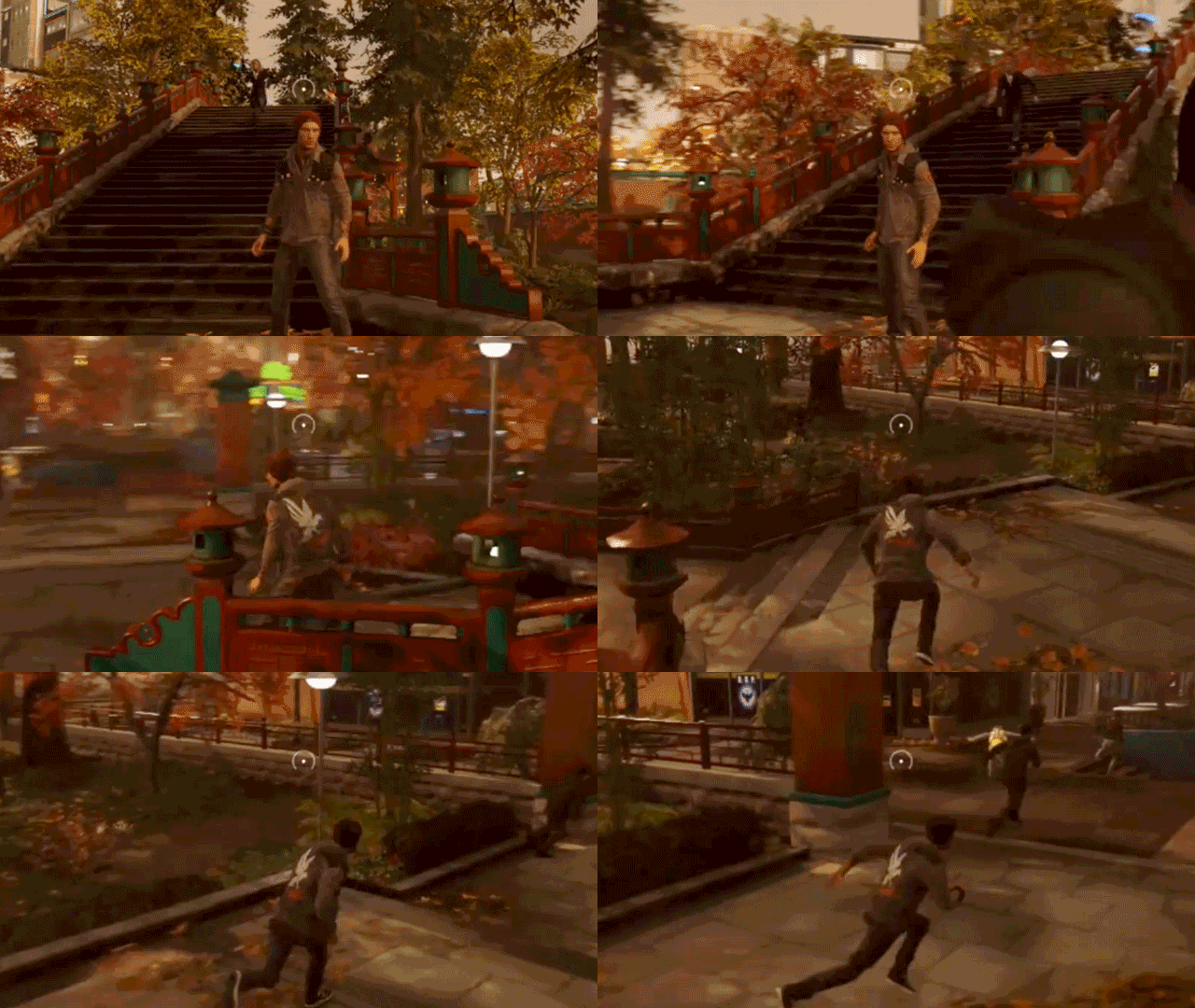
Today’s the day when the latest installment in Sucker Punch’s open-world action/adventure series launches up, up and away into PS4s all over the planet. While it resembles its predecessors a fair bit, Infamous: Second Son does do a few things differently than them. Check out the advice below for ways that you can be a more super superperson.
How much of your humanity are you willing to give up for even the slightest chance of victory?
Dark Souls II asks this question of you at every turn, encouraging you to press onward in spite of imminent death. And with each death, you lose a little of your humanity and become more hollow. Your maximum health slightly diminishes each time as well, eventually sinking to 50 percent of its full value, and yet as each sliver of humanity is sliced away, you heed the call to move onward. Eventually, you overcome the obstacle that stood between you and victory–that quartet of gargoyles swarming you on a rooftop, that arachnoid demon plunging poisonous pincers into your flesh, that disgusting mound of meat that defies description. You have triumphed! But your gain does not come without sacrifice. You have sworn, you have gasped, and you have sweated. You have forfeited your own humanity so you might collect the souls of the damned.
Like Dark Souls and Demon’s Souls before it, Dark Souls II is not just a fantasy role-playing adventure, but a cloud that hangs heavy over your head whenever you so much as think about it. These modern classics developed by From Software have rightfully earned a reputation for being brutally difficult, but their beauty is derived not solely from difficulty, but also from dread. Dark Souls II is not a survival horror game in the normal sense, but few games can make you this afraid to peer around the corner, while simultaneously curious as to what awaits you there. Death is so very beautiful in this game, for it comes at the hands of amazing beasts and warmongers: hulking armored knights, shimmering otherworldly invaders, and tendrils that rise out of black pools of poison. Sure, each death punctures your heart, but one of Dark Souls II’s many gruesome pleasures is discovering new ways to die.
Embrace the darkness, lest it consume you.
The eerie blackness is front and center as you start up the game and enter the mysterious abode in front of you. Three old crones await you inside and ask you to customize your character and choose a class before venturing into the unknown. Like most of Dark Souls II’s characters, these women offer vague advice and refer to events and concepts without filling in the details. The anxiety mounts as you weave in and out of the nearby caverns that fill you in on the basics of movement and combat. This area may teach you the fundamentals, but it also raises a number of questions. What are those odd voices you hear when you stand near the bird’s nest that rests on a narrow ledge? What is the significance of the flame sconces scattered about that you are meant to set alight? How do you survive encounters with the monstrous ogres on the beach below that squish you like a measly bug when you draw near?
Welcome to Drangleic, a world that is not quick to whisper its secrets to you, in a game that trusts you to find the answers for yourself.
Welcome to Davy Jones’ locker.
This introduction is not as soul crushing as the original Dark Souls’ opening, but that’s just fine, for Dark Souls II offers you an early taste of hope, a feeling that was quite rare in its predecessors. That hope arrives by way of Majula, a gorgeous oasis that’s as close to a home as you will find in the game. My first glimpse of Majula was a revelation. As I emerged from the nearby shadows, the glowing sun blinded me, and I stood in awe of the world opening up before me. Whenever the bleakness of Drangleic at large overwhelmed me, I was glad to return to this hub for an emotional refresh.
Majula is more akin to Demon’s Souls’ Nexus than to Dark Souls’ Firelink Shrine. It is your central hub of operations, and while it’s mostly devoid of life when you first come upon it, it slowly fills out with the vendors you meet upon your travels, many of whom set up shop there. Your most important contact there, however, is the cloaked woman who allows you to level up in exchange for souls, the game’s currency. But even Majula is not immune to mystery. There’s an impossibly deep hole in the ground here, one that spells certain death if you fall into it. (Don’t let it fool you; the boards that crisscross this passage may look high enough to provide a safe landing, but you will not survive that fall.) What’s down there? Surely something valuable must lurk down there. Or something horrifying. You eventually make your way down, but Dark Souls II doesn’t tell you when or how that may happen.
Death is so very beautiful in this game, for it comes at the hands of amazing beasts and warmongers: hulking armored knights, shimmering otherworldly invaders, and tendrils that rise out of black pools of poison.
Instead, Dark Souls II trusts you. As in its predecessors, there are no waypoints, and there is no quest log. Instead, you simply head out into Drangleic seeking to light primal bonfires and thus restore some dignity to this decrepit land. The only way to defeat the defiant creatures that guard the bonfires, however, is to grow stronger by murdering enemies and collecting their souls, which you then spend on new levels, new armor, and other trinkets that strengthen your resolve in battle. If you’ve played the earlier Souls games, you should take to the combat quickly. You feel each swing of your axe, each stab with your spear, and each fireball you lob. Timing is key: every action leaves you vulnerable, so you must pay close attention to the rhythm of your enemies’ attacks and strike at the opportune moment. Managing your stamina is also vital to success. Every attack you launch uses up stamina, as does successfully blocking an attack. You can’t simply flail about with abandon; this is not that kind of game, and not taking care during every encounter will get you killed.
Watch your step: that undead soldier is not your biggest threat.
Not that you shouldn’t expect death. Dark Souls II is built around your repeated demise. When that inevitable moment comes, you drop all the souls you were carrying and must retrieve them if you don’t want to lose them permanently. You get only one chance to get them back, for dying before you reach them eliminates them from the world forever. Of course, this mechanic is nothing new: it’s the same concept that powered both Demon’s Souls and Dark Souls, after all. But just as Dark Souls represented a structural change over Demon’s Souls, so too does Dark Souls II over its predecessor.
Some of the differences are noticeable early on, though their benefits aren’t always immediately clear. I was not sure how I felt about one such change: the limited enemy respawns. Each time you die or rest at a bonfire, the world is refreshed and the standard defeated foes respawn. Or at least, that’s how it used to happen. In Dark Souls II, there comes a point when many local enemies don’t respawn anymore, allowing you freedom to progress with fewer obstacles in your way. It’s true that infinite respawns encouraged grinding, particularly when the enemies you faced dropped important items. But that repetition also instilled a bizarre connection between player and game. I can still clearly remember, for instance, exactly how to progress through Dark Souls’ Undead Parish–where each enemy is, what attacks it will use, and what precarious drop-offs I must keep a lookout for. When I first encountered the limited respawn system, I worried that the sequel had lost a vital element that would keep Dark Souls II from commandeering my waking and sleeping thoughts.
How much of your humanity are you willing to give up for even the slightest chance of victory?
As it turns out, I shouldn’t have worried. The grinding opportunities are still there, and there are in-game items that force enemies in a given region to begin respawning again (and make them more powerful, to boot). Dark Souls II’s hook isn’t the endless cycle of enemy death and resurrection, however, but the promise of new and exciting places to explore, and new and exciting foes to face. And that hook is supported by any number of subtle changes to the formula. For example, once you activate a bonfire, you can warp to it from any other bonfire without having to pass through perilous places over and over again. Again, I didn’t immediately take to this change, but once I discovered just how vast Drangleic was–it’s decidedly bigger than Dark Souls’ Lordran–I embraced the structural tweaks.
Even playing offline doesn’t immunize you against invasion.
These changes might not have worked had Dark Souls II not made discovery such a thrill, but with each new area comes a new wondrous vista and a new challenge to overcome. The early forests and ruins are very Dark Souls, but the intricate architecture and carefully planned enemy locations make even familiar-looking environments fresh and unique. The more progress you make, however, the more unusual the settings become, and the more you need to consider new methods of approach. Suddenly, undead freaks are flinging themselves to the ground and exploding, and so you must hasten your rhythm. You walk through an archway and into the thickest fog imaginable, where you cannot lock on to the ghostly shimmers that attack you. Poison rains from the sky, bedeviled urns curse you when you linger near, and anthropomorphic tortoises stop, drop, and roll all over your puny body. Dark Souls II wants to kill you, but the cycle of death and rebirth is worth it if it means finding the royal ring that lets you open that giant door and discover what new and wonderful lands lie beyond it.
Those lands are incredibly striking. Given reports of Dark Souls II’s new engine, I was disappointed by the game’s lighting, which was flatter than I had hoped, thus rendering my torch less vital for providing dynamic light than it might have otherwise been. But to fixate for too long on this single visual element sells the fantastic art design short. Make your way past Harvest Valley’s poisonous pools–and the fantastic monstrosities that fire orbs of darkness at you–and you can only marvel at all of the windmills that lie before you. Of course, this is Drangleic and not the Netherlands; those windmills are not quaint landmarks, but harbingers of disease and death. Then there’s Iron Keep, which takes lava levels to a whole new height of fiery doom. There are very occasional frame rate issues that intrude on the grim elegance, but nothing on par with Dark Souls’ Blighttown struggles.
Poison rains from the sky, bedeviled urns curse you when you linger near, and walking tortoises stop, drop, and roll all over your puny body.
And so Dark Souls II is hard–but is it harder than the original? No. I certainly did my share of shouting while playing through Dark Souls II, pitting my bastard sword against Drangleic’s powerful protectors, but nothing caused me controller-flinging frustration the way Dark Souls’ Ornstein and Smough did. Nor did I ever snarl and growl the way I did when making my way through the original game’s Sen’s Fortress, let alone facing Demon’s Souls’ red dragon. But don’t overestimate any rumors that Dark Souls II isn’t a great challenge. Trudging my way through shin-deep water while avoiding nearby mages’ magical homing missiles was not easy. I yelled when I slipped into a drop-off while focused on the mean wizards, and cursed when sea dwellers swiped me from behind while I blocked oncoming attacks. And then, finally, when I reached the foggy door that led to a new area, I was able to breathe–at least until I realized there was a gross boss monster behind that door.
I must give credit to Dark Souls II for making combat feel as fair as it does. The Souls games have always given you the tools to succeed, but while playing the newest entry, I was impressed by how it balanced new challenges with subtle ways to help you succeed. Sometimes, the path to success is relatively obvious, like using a lever to dunk baddies in boiling lava, or luring an armored turtle under a blade and watching the makeshift guillotine slice the half-shelled villain in two. Other possibilities are so subtle as to be obtuse, rewarding thorough investigation with an unexpected boon. Is poison complicating a battle against an evil queen? Is darkness inhibiting your ability to lock on to a pouncing behemoth? There might be some help out there, just hidden from view. Dark Souls II trusts you to find it–or if not, to overcome without it.
Burn, baby, burn.
Just as before, help comes from other players as well as from the game itself. Every Dark Souls II player is intertwined in a comforting web of ambiguous communication. As before, you see the spirits of other players as they journey through their own copies of the grotesque wilderness. You teach them (or mislead them) by forming messages out of predetermined phrases and leaving them on the ground for others to spot. You even teach them with the mere act of dying, leaving a bloodstain that others might touch to witness your ghost reenact the last precious seconds of your life. And if you feel truly cooperative, you can offer your services to other players, who can then summon you in for assistance with a troublesome boss.
Bigger isn’t always better.
You can also hinder other players by invading their worlds, just as before, though certain additions to online play keep battles more dynamic than ever. The notification that you have been invaded is still a stomach-churning event, as is the first sight of the red phantom that represents the other player. But your invader is not necessarily invulnerable to the undead soldiers that populate Drangleic–not if you use a particular item designed to make monsters turn on your human enemies. Luring an invader into a trap–look out for the creature with the scythe!–is an absolute delight, though you need to make sure you have your wits about you: the only thing scarier than seeing your evil intruder is not seeing him.
There’s so much more to talk about with Dark Souls II. There is the fantastic stretch near the end of the game that fleshes out the story by involving you in grander battles than you would expect from this series. Then there are the covenants–fellowships that bond you with other players and give you more tools to assist or annihilate each other. Joining one covenant allows other players to come to your aid should you be invaded; joining another lets you battle against characters from the original Dark Souls. How some of these covenants may change the very feel of the game is still unclear at this early stage, but having joined the Bell Keeper covenant, I look forward to being summoned to other worlds and preventing others from reaching the tops of their belfries and sounding out the bell that sways there.
Dark Souls II is loaded with secrets and surprises, and even though I have finished the game once, there are so many elements I am still uncovering. I may not have yet unveiled all there is to know about this beastly game, even after 80 hours of play, but I do know this: I will be adventuring through Drangleic for many months to come, sure to be haunted nightly by the disturbing gazes of the faceless titans that tenderize my flesh with their two-ton hammers.
Help yourself to a serving of the first official footage from the next-gen only Assassin’s Creed Unity. Stay tuned – we’ll have many more exciting details for you in the future.