The year is 2183 and the planet Earth is a write-off. You are sent into space with the purpose of discovering a new hope for humanity. It’s a high-stakes mission, but the trip takes a turn for the worst when your ship crash lands on an uncharted planet and you must embark on a fight against the elements. The objective shifts to survival. This is where The Solus Project begins.
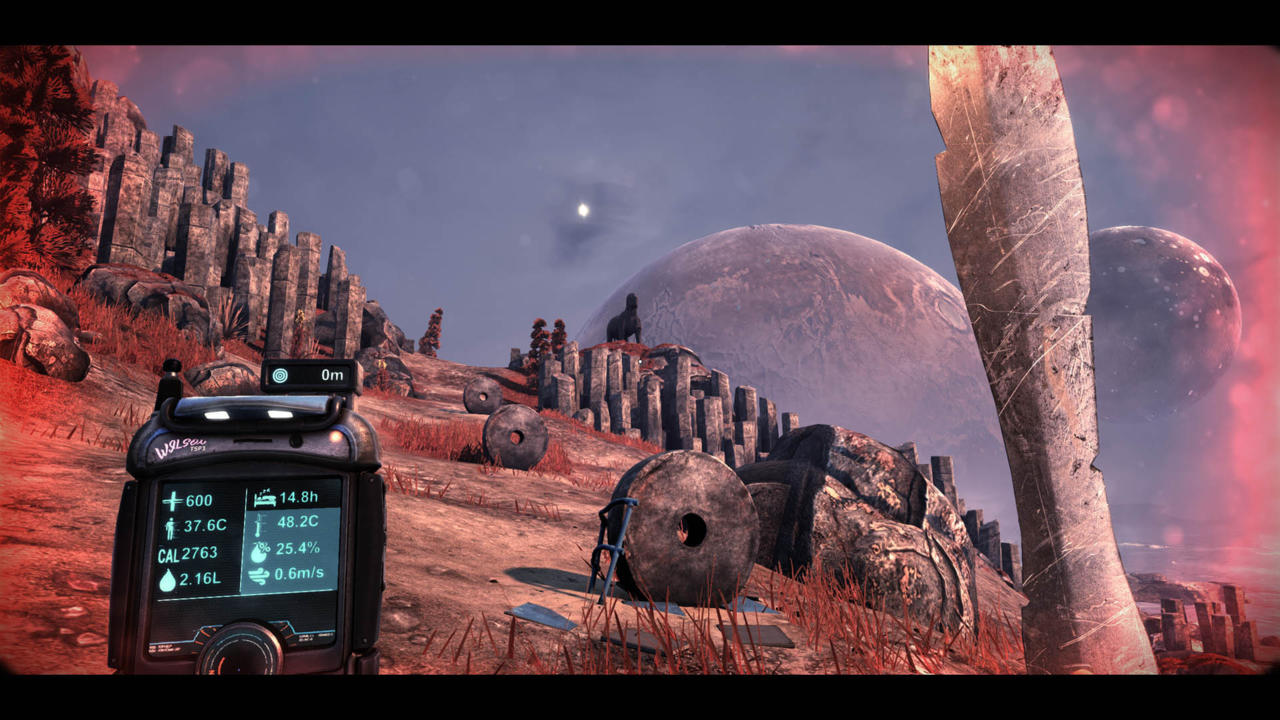
I played an early build of The Solus Project at E3 2015, where I explored mysterious and dank caves, was caught in a meteor shower, and found myself at one point face-to-face with a tornado. The game puts great emphasis on survival, with the protagonist’s hunger level, thirst, body temperature, and surrounding humidity and wind just some of the factors that are monitored in-game. This is displayed on the main character’s PDA device, which is held at all times and can be viewed in its entirety by looking down.
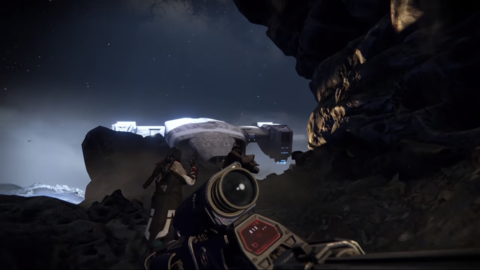
Exploration is paramount to survival in The Solus Project, and I the first thing I did was set to stalking around my ship’s crash site to scavenge supplies. My first instinct was to pick up every single object I laid eyes on, but I soon found myself with a full inventory and unable to gather any more. I needed to prioritize what to take with me. While I walked around contemplating this, a meteor shower started up and rained hazardous flaming rocks down around me. The environment is the most dangerous enemy in The Solus Project, which will feature a dynamic weather system and day/night cycle. Even the status of the moon will control the flow of the ocean tide, and plants will grow and rot away.
The Solus Project will feature a crafting system that allows players to apply items together to create new ones. For example, I gathered two rocks and dropped one on the floor. I then equipped the second rock and used it to apply to the first, which was on the floor, to create a sharpened rock. Using my newly acquired sharpened rock, I cut away some vines growing on a nearby cave wall. These vines I applied to a pipe I had picked up earlier and fashioned into a makeshift torch. I am interested to see how deep the crafting system will run in the full game, with so many materials potentially available in the environment.
But the planet I was stranded on had clearly been inhabited by civilization at one point. Elaborate tombs hidden in caves were waiting to be unlocked and explored. The entrance was locked, but conveniently within walking distance of the key which I needed to use to open it. Which was just as well, because a flash storm suddenly spawned and threw a whirling tornado perilously close by. The demo concluded as I entered the hidden tomb, curious and ready to learn more about the mysterious civilization which once inhabited the planet.
While the demo made use of waypoints to provide guidance, I was informed that the final version of the game will place more emphasis on allowing players to explore and figure out solutions to problems independently. The Solus Project is scheduled for release on Xbox One and PC in the first quarter of next year. I’m curious to see how my survival skills shape up on the full version of the game when it’s out.
It was the most explosive choose-your-own adventure game I’ve ever played. At E3 2015, I joined my fellow CBS employees from Giant Bomb in chatting with representatives from Avalanche Studios about the upcoming Just Cause 3. Rather than play the game for us, producer Omar Shakir and crew led us through a series of videos in which we got to choose from several options on how protagonist Rico should destroy the object at hand. And unsurprisingly, the Mediterranean-esque island of Medici has a lot of things needing to be destroyed.
You can destroy them using the dual tether, Rico’s most enduring tool, using moves Avalanche gives such names to as “Farmer’s Revenge,” “Stop Hitting Yourself,” and “Cartapult.” These moves come courtesy of the tether’s many improvements: it no longer auto-retracts, and you have multiple tethers you can deploy at once. Fewer mechanical limits means fewer limits on how you blow stuff up, which is your primary goal (and primary joy) in Just Cause 3. Try tethering multiple objects to fuel pumps at a petrol station, then retract your tethers and watch the fireworks begin. The resulting explosions are so enormous, they create miniature mushroom clouds, and might make you fear for your safety the next time you pull over to fill up your gas tank.
You can destroy them using vehicles, which Shakir says control a lot tighter and allow you to drift and e-brake around tight corners. As you drive through sunflower fields, all the vegetation bends or breaks, and you can level a forest should you set off a series of explosions in the right place. Vehicles aren’t limited to sports cars and buggies, however. Why not hijack an oceanic destroyer and annihilate a tanker, a seaside installation, or even an entire bridge with its cannons? Watching that bridge collapse into rubble and splash into the inlet below is a primal treat.
You can destroy them by performing improbable stunts–say, by hijacking an aircraft, freely walking around on its surface as it soars through the air, parachuting away, and firing rocket-propelled grenades at a tower as the aircraft plunges into the base surrounding that tower. Then there’s always just straightforward overkill with a tank: drive into the base, aim your cannons, and start the mayhem. Or maybe you’d prefer to drive a motorcycle up a ramp, activate your parachute, tether a soldier to an explosive canister, and then watch the canister lift off, taking the hapless soldier with it. There are limits to the destruction, as there must, or Rico would run out of objects to grapple to, but Just Cause 3 looks to join the Red Faction games as the most destructible action adventures to have yet been built.
Getting from one destructible place to another is vital, and thus we have Rico’s wingsuit, which, when combined with the grappling hook, allows you to slingshot yourself along the ground like a low-flying aircraft. I’m delighted by how fast you move in this manner: Shakir says that like the rest of Just Cause 3, the wingsuit is grounded in physical reality while still remaining fun to use. I think, however, that this is a “physical reality” that belongs between quote marks. Just what are the lines that Avalanche draws between “this crazy thing is reasonable” and “this other crazy thing is not?” At what point would Just Cause be officially jumping the shark?
“We have a very good shark hunter,” says Shakir, referring to Christofer Sundberg, Avalache’s chief creative officer. “When you bring a wing suit, a grappling hook, and a wingsuit into a game, and you want to physicalize them, if you start having lasers and dinosaurs, then what’s the point of physicalizing them? There’s a balancing act when you’re going for the Tropic Thunder/Expendables vibe. You need a strong DNA and a strong backbone, and Christofer’s the person who helps drive, ‘that doesn’t really fit, it’s a little too much’.”
“It’s quite simple,” adds Sundberg. “We don’t go sci-fi, we don’t do aliens.” Two rocket launchers at once? That’s a fantasy he can get behind. “Explosions can always get bigger, you can always drive faster, that’s where there’s no limits.” Besides, Avalanche always has a dinosaur game, called The Hunter: Primal. Just Cause has no need for them. What you do need are air drops, anytime and anywhere; you can even summon a giant jet, if you manage to unlock it, but again, this is a physicalized world (Avalanche loves the word “physicalized”), so that thing could go tumbling if you aren’t careful. If you drop a vehicle in the wrong (or right!) place, something’s gonna explode.
Story played a role in Just Cause 2–an annoying role, filled with broad accents and some frustrating missions, such as an escort mission that still stands out for me as one of the worst of its type in any game. The Avalanche team acknowledges that said mission was not their best moment–and also acknowledges that telling a story is tricky in an open-world game that gives the player so much freedom and power. Story allows Avalanche to funnel players through key set pieces and fully designed spaces. But, as Shakir says, a story also provides a punch line. “If you remove it completely, then it’s just some guy running aimlessly around shooting in all directions. You need the backbone and you need context. And I think with Just Cause 3 in particular, digging a little deeper on who Rico is as a person, perhaps not via Rico specifically, since he’s an action movie hero kind of person, but maybe with people from his past, can give you an idea about who he is. Blowing up things can be a little more interesting when you have that background.”
That’s not to say that Just Cause 3 is going all serious; that kind of storytelling wouldn’t be consistent with the silliness inherent to the gameplay. There is lots of camp and comic relief, though Avalanche is granting a certain kind of logic to Rico’s behavior. In Just Cause 2, Rico was practically a bad guy himself, destroying Panau with no thought to how that might affect its residents. (He fought for their freedom, but freedom on an island wasted by explosions and annihilated villages doesn’t sound very appealing.) Avalanche actually put some thought into this aspect of Just Cause 3. You’re not hurting civilians by destroying their villages: You’re hurting the island’s dictator and his evil forces by destroying their bases and supply lines.
December 1st: It’s an easy date to remember, so there’s no reason to forget Just Cause 3’s release date. When the holidays approach, you can spend them getting to know every nook and cranny of the island of Medici, a very nice place to blow stuff up.
The Xbox One may be trailing behind the PlayStation 4 in the current-generation sales race, but Microsoft has high hopes for its console this holiday. Speaking with GameSpot this week at E3 2015, Microsoft executive Aaron Greenberg said a string of blockbuster exclusive games and new backward compatibility functionality will lead to a “massive migration” of Xbox 360 owners moving to Xbox One.
“A lot of people have been waiting for the next Halo; a lot of people have been waiting for Gears; a lot of people have been waiting for backwards compatibility,” Greenberg said.
“And so we think having all of that coming this holiday; we expect we’re going to see a massive migration,” he added. “We expect millions of Xbox 360 owners to migrate and move to Xbox One. We see that the majority of people who buy an Xbox One today own an Xbox 360. So our fanbase has stayed very loyal. And frankly, they’re waiting for those new releases to come this year.”
Greenberg stressed that you should not underestimate how pivotal backwards compatibility will be in encouraging people to upgrade from an Xbox 360 to an Xbox One.
You can watch our full interview with Greenberg below.
When developer Bungie announced Destiny’s next expansion, The Taken King, I was skeptical of its story. I was not particularly impressed with the narrative in the base game. But I was able to go hands-on with the first mission in The Taken King, and I came away believing that Bungie is pushing hard to make this expansion’s story special.
When the mission started, I dropped onto Mars’ moon, Phobos, a new location in Destiny. The sky was full with ships and in the distance and the red planet hung in the sky. I started running along a cliff toward a structure. A massive Cabal ship rose up over the cliff, only a few feet from me, but it quickly flew away. As I rounded the corner and came into view of a Cabal war base, sounds of fighting and destruction rose in my ears. I spotted forms of Cabal and my mind prepared for combat. These Cabal, however, were dying. One crawled for a few seconds and then fell prostrate at my feet. Another was just a heap by the building. Something ominous was happening and murdering all of the Cabal. Something had shifted in Destiny’s world; I was not fighting the normal enemies any longer.
This is just the opening of the next chapter in Destiny’s story, and the sinister atmosphere weighed heavily across the entire thing. Later in the level, I encountered the new enemy type, the Taken, for the first time. The black-and-white enemies shudder and shift, as if they’re caught in between worlds. They take on forms that you’ve seen before, but they behave in very different ways. Salvos of rockets join the familiar guns and melee attacks, and some of the foes split into two.
All of this contributes to a level that seems so original compared to the rest of Destiny. From what I saw, The Taken King isn’t shying away from going in a different direction and expanding out the Destiny experience. Using the Hunter’s new Shadowshot super move, I tied together a bunch of the fallen and picked them off with a great new pulse rifle. Phobos looks like no other Destiny environment, with Cabal architecture blending with dark Hive caverns. The story seems more in-your-face and more immediate.
In fact, it feels like some of the epic Halo campaign levels that Bungie is famous for. The Taken King channels those memorable moments in Halo when you see the Flood coming in and battling with a huge Covenant fleet. This mission had that same feeling of surprise and unease when I saw the Cabal brought to their knees by an unseen force.
It seemed so new to the world of Destiny. The scale of this mission far exceeds the majority of the original Destiny campaign. Its reveal is impactful, and I genuinely experienced fear when I saw the Cabal brutally and mysteriously killed. I loved my time in the demo, exploring a world that I had never seen before and discovering secrets of Destiny lore. The Taken King is shaping up to be a great time to start playing Destiny again, and it’s sure to appeal to Halo fans who have been wanting Bungie to return to its roots.
As the level drew to a close, I recognized Bungie’s efforts to improve the story and the world. The demo I played made me very optimistic for the future of Destiny’s narrative.
Microsoft did not talk about its motion-sensing Xbox peripheral Kinect during the company’s E3 briefing this week or at all during the show itself. Some fans might be wondering how committed Microsoft is to the technology considering it didn’t take any time to talk about it at the year’s biggest gaming show.
But now, Xbox executive Aaron Greenberg has spoken out to assure fans that Kinect is here to stay.
“We are absolutely continuing to support Kinect,” Greenberg told GameSpot this week at E3.
He went on to say that Microsoft is “innovating with Kinect in a different way,” pointing out that there are features included with the new Xbox One user interface that will leverage Kinect. One of these is Cortana, Microsoft’s Siri-like digital assistant, that will be available on Xbox One sometime in the future.
“So we’re continuing to support Kinect where it makes sense,” Greenberg added.
When the Xbox One launched in November 2013, all Xbox One bundles came with Kinect. But this changed a year later, when Microsoft released a Kinect-free bundle and offered the camera as an optional add-on. Greenberg stressed that consumers having a choice is an important part of the overall Xbox One strategy.
“We really want Kinect to be a choice for customers. For me, I love it; I turn my Xbox One with Kinect; I use it for entertainment; I use it to do screenshots and all that,” he said. “I like to be able to have my hands on the controller and use voice commands. But, frankly, a lot of people also want a better value and don’t want to have to pay for it. So we’re not going to force people to do that. We give people the choice.”
You can watch our full interview with Greenberg below.
It feels like it just started, but we’re here at the final day of E3. Before we say goodbye to the Los Angeles convention center, we have one final roundup of the best content from our expansive show coverage.
One of the biggest pieces of news out of E3 this year came from Microsoft on Monday morning, when the company announced Xbox One backward compatibility support for Xbox 360 titles. Now, Sony executive Shuhei Yoshida has responded to the news, calling it “interesting,” and stating that the company has no immediate plans to offer native backward compatibility on PlayStation 4.
“The technology involved must be very challenging,” Yoshida said in an interview with Polygon.
Xbox One backward compatibility is available now for Xbox Preview members, and will roll out to everyone this holiday. At that time, the initial list of supported games will be expanded to “hundreds” of digital and physical Xbox 360 games. System-wide Xbox One features, such as DVR and streaming, will be available for all Xbox 360 games.
The PS4 does offer some kind of backward compatibility by way of PlayStation Now. However, this is a paid streaming service. But could the PS4 ever offer a native backward compatibility solution?
“I don’t think we will change our approach,” Yoshida said. “The PlayStation 4 doesn’t have backward compatibility.”
He went on to say that Sony will instead focus on building new features and services for the PS4. But Sony hasn’t ruled out native backward compatibility entirely.
“Backward compatibility is hard,” Yoshida explained. “I won’t say we’ll never do it, but it’s not an easy thing to do. If it was easy we would have done that.”
Now that retailers are accepting preorders for Fallout 4, one superfan has attempted to pay for the game with bottle caps, which are the in-game currency for the post-apocalyptic RPG series.
“Fallout 3 was my favorite game for several years, so I made the rational choice to start saving up bottle caps. Turns out 4.5 years of undergrad and three years in a Master’s program leads to a lot of drinking.”
In all, GatorMacheteJr sent more than 2,000 bottle caps (weighing more than 11.2 pounds) in a box to Bethesda, in hopes that they would accept them as payment for a copy of the game.
Also included in the box was a note to Bethesda’s PR department; you can read it in the gallery below.
It’s not known if the box has reached Bethesda’s offices in Maryland yet or if the company will actually honor the request. GatorMacheteJr says they’ll keep everyone updated.
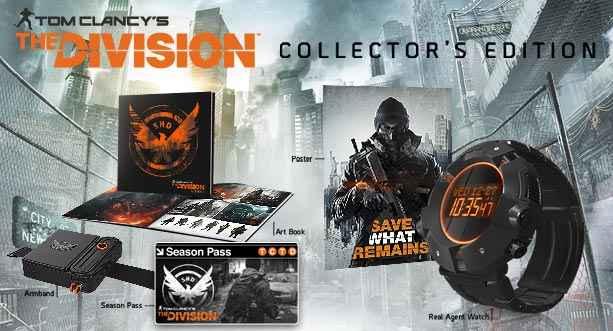
[UPDATE] Ubisoft’s own Uplay store has posted a product page for the $160 collector’s edition. Check out an image of the premium bundle below.
The original story is below.
The Division, like so many other AAA games today, is getting a DLC pass. Ubisoft made the announcement on Friday as part of its E3 briefing in Los Angeles. The existence of the DLC pass comes as part of the announcement of two premium versions of The Division.
The Gold Edition comes with the game, an “exclusive” National Guard Gear Set, and the Season Pass, which comes with a “full year of major expansions and exclusive benefits.”
The Division’s Collector’s Edition, meanwhile, contains everything from the Gold edition, as well as “an array of exclusive memorabilia including the Agent Watch Replica.”
Ubisoft also announced today that all preorders for The Division will come with guaranteed access to the game’s beta, which begins first on Xbox One in December. What’s more, people who preorder will receive the Hazmat Gear Set for their character. More information about The Division’s beta is available here.
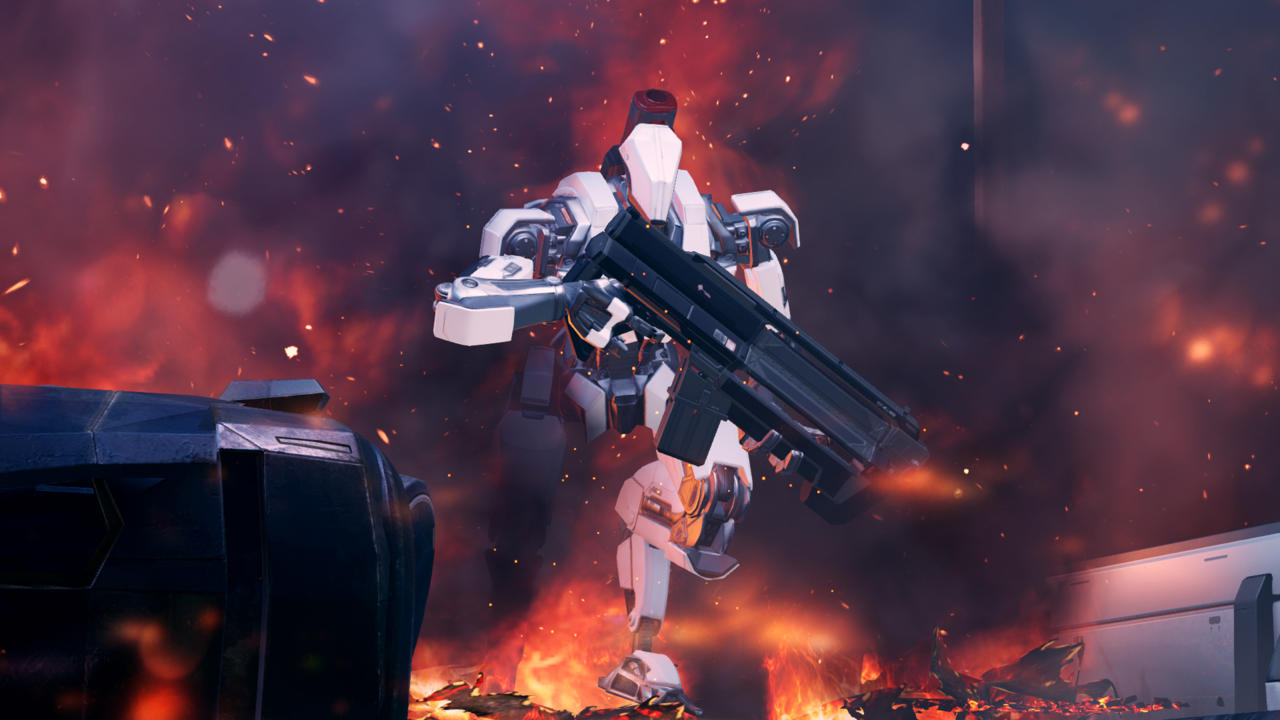
In XCOM: Enemy Unknown, your soldiers needed to recover alien technology to advance their own scientific knowledge and construct better equipment. This was done automatically at the conclusion of each mission; you would receive a certain amount of alien technology to be researched and reverse-engineered. In XCOM 2, a new looting system means you can manually recover even more valuable technology from the corpses of enemies, and place it in your soldiers’ new backpacks.
“You’ll be able to take them back to base and do some very, very cool stuff–such as customising your weapons, and customising the inherent attributes of your soldiers,” says Garth DeAngelis, lead producer on XCOM 2.
Players of XCOM: Enemy Unknown have found ways to customise their soldiers’ stats in the form of gameplay mods. But that customisation was limited, and now that XCOM 2 is PC-only, the modding support this time around is going to be more fully-featured. “We’re going to have Steam Workshop support, and the Unreal editor so you can do total content conversions,” says DeAngelis. “And we’re going to release the gameplay source, so you can do partial edits to existing abilities and stats.”
One new system that isn’t based on stats is the concealment phase, which DeAngelis says allows the player to “take on the role of the invader”. Because XCOM is bringing down a corrupt alien-government alliance, your soldiers need to infiltrate enemy territory. They begin the mission in a state of concealment, which means enemy units aren’t immediately hostile when they enter your line of sight. Instead, a smaller detection radius surrounding enemies allows you to sneak closer and assume advantageous positions without alerting them. Some enemies will follow patrol routes, and you can remain hidden if you’re behind full cover when an enemy looks in your direction and walks past.
“You want to turn the tide of battle and take out that first group as efficiently as possible, and then the alarms go off, and they know you’re there,” DeAngelis adds. “Reinforcements may come. And then, it’s a more classic XCOM. We’ll be able to push on that with some later-game abilities that we’re not talking about yet. You can do some unique stealth things with them.”
Once combat does start, the increased destructibility of cover means that you’ll be in more danger—but some interesting tactical opportunities could also arise. “Let’s look at the foundation of XCOM,” DeAngelis proposed. “You have cover. What’s the most terrifying thing that can happen to you? Cover is suddenly ripped out from you. There are still toughness levels on cover, so depending on the type of ammo you have, the type of weapon tiers, cover will either stick around or go away. In the demo, the Advent were using magnetic weaponry, so that takes out baseline cover much quicker. But the other cool thing about destructibility is, if you’re in a building, and you have a unit on the second floor, or the roof, if someone shoots at you, that floor could go out from under you at any time and you can fall through–which is an homage to the original XCOM: UFO Defense.”
The way Firaxis is encouraging more dynamic events in combat carries over into the way XCOM 2’s missions are designed. Not only will every map’s layout be procedurally generated, but so will that map’s objectives.
“In EU, you had kill missions, and scripted VIP rescue missions,” DeAngelis explains. “Now, we’re sort of combining the two, within a very procedural system. Not just procedural maps, but now there are gameplay mechanics layered on top, where you don’t know exactly what you’re doing when you go in. It could be recovering intel, hacking a workstation, destroying a building–and they’re not scripted like they were in EU. They work based on a number of parts in the procedural system. So it’s super replayable.”
XCOM: Enemy Unknown fans will be familiar with that replayability, having most likely lost the game at least once and failed to repel the alien invasion. DeAngelis says the team actually has data that shows most players lost the campaign at least once, which is why XCOM 2 follows on from a scenario in which XCOM essentially failed.
“We’re not a movie; we’re not a book; we’re not beholden to what story we want to tell. What’s more interesting to us is what actually happened to players–their actual experience with the game. And that led to this–XCOM lost, the aliens occupied Earth, and that’s a reason to bring XCOM back 20 years in the future. They didn’t finish the job. For the players that did win the game, it doesn’t undermine what they did. In that universe, XCOM isn’t needed–you won the game. Your personal experience after you probably lost once or twice, you won and had that sense of triumph. But, there’s also a universe where XCOM lost. That’s what we want to tell with this story.”
And what does that mean for the Council of Nations, the mysterious body of powerful people that funded the original XCOM project? “You’ll have to wait and see,” DeAngelis teases. “There might be some continuity there.”
XCOM 2 launches in November exclusively for the PC.