Category: Classic
-
Telstar
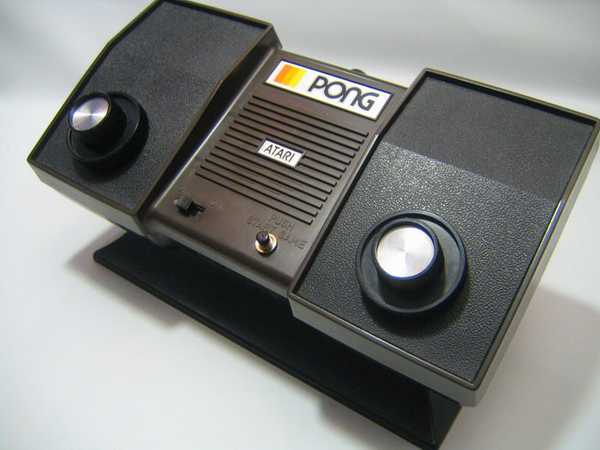
The Telstar is a series of video game consoles produced by Coleco from 1976 to 1978. Starting with Telstar Pong clone based on General Instrument’s AY-3-8500 chip in 1976, there were 14 consoles released in the Telstar branded series.
Telstar was a series of video game models made by Coleco which preceded the Colecovision by 10 years. “Telsta”, Coleco’s first videogame system was releases in 1976 and played only three games with three difficulty levels. It was the first system to use the GI’s AY-3-8500 chip, and was a huge success. The system sold over a million units. There were even two variants: one sold by Coleco in Canada as “Telstar Deluxe”, and another (same) sold by Montgomery-Ward under the name “Telstar Video World of Sports”

Telstar – (model 6040, 1976) Three Pong variants (hockey, handball, tennis), two paddle controllers fixed on console. This was the very first game to use the AY-3-8500 chip.
Telstar Classic – (model 6045, 1976) Same as the Telstar, with deluxe wood case.
Telstar Deluxe – (1977) aka “Video World Of Sports”, same as the Telstar but brown pedestal case with wood panel, made for Canadian market with French and English text.
Telstar Ranger – (model 6046, 1977) Four Pong variants (hockey, handball, tennis, jai alai) and two gun games(target, skeet), black and white plastic case, includes revolver-style light gun and separate paddle controllers. Uses the AY-3-8500 chip.
Telstar Alpha – (model 6030, 1977) Four Pong variants, black and white plastic case, fixed paddles. Uses the AY-3-8500 chip.
Telstar Colormatic – (model 6130, 1977) Same as the Telstar Alpha but with detached wired paddles as well as color graphics. Uses the AY-3-8500 game chip and the Texas Instruments SN76499N chip for color.
Telstar Regent – (model 6036, 1977) Same as the Telstar Colormatic but no color and black and white case.
Telstar Sportsman – (1978) Similar to Telstar Regent, but with an additional light gun and different setting switches.
Telstar Combat! – (model 6065, 1977) Four variations on Kee Games’ Tank, four fixed joysticks (two per player), uses a General Instruments AY-3-8700 Tank chip.
Telstar Colortron – (model 6135, 1978) Four Pong variants, in color, built in sound, fixed paddles, uses AY-3-8510 chip.
Telstar Marksman – (model 6136, 1978) Four Pong variants and two gun games in color, larger light gun with removable stock, fixed paddles, uses AY-3-8512 chip.
Telstar Galaxy – Separate joysticks and fixed paddles, uses AY-3-8600 game chip and AY-3-8615 color encoder.
Telstar Gemini – (1978) Four pinball games and two light-gun games in color, light gun, two flipper buttons on left and right sides of case, pinball launch button and field adjustment sliders on top, light gun, uses a MOS Technology MPS 7600-004 chip.
Telstar Arcade – Cartridge-based, triangular case includes light gun, steering wheel with gear shift, and paddles, one on each side. Each cartridge includes a customized MOS Technology MPS-7600 chip. The chip contained custom logic circuits driven by a basic processor which ran a very small program stored in ROM.
The large product lineup and the impending fading out of the Pong machines led Coleco to face near-bankruptcy in 1980. -
Atari Pong
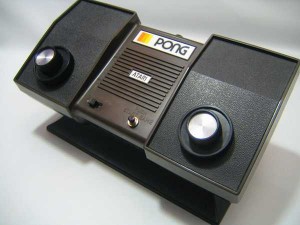
After Ralph Baer and Magnavox proved that home video game systems were feasible, Atari’s Al Alcorn was eager to do a home version of Pong. His project was code named “Darlene” after a female coworker that worked with Alcorn at the time. In the fall of 1974, Alcorn began developing the “Darlene” system. Several months later Atari released Home Pong. Home Pong was aptly named. It only played Pong. If you were to have opened one, you would have found only three LSI’s and a few other distinct components such as transistors, capacitors and conductors. Due to new technologies available, Atari was able to achieve a higher resolution than Magnavox’s Odyssey., thus making the resolution dependent controls more responsive. While Atari’s profits had been high in the arcade arena, they were not quite financially equipped to permeate the home console market. At the time, the video game companies were either arcade only (such as Baily) or home console only (such as Magnavox). The two markets were dramatically different requiring separate technologies, and distribution networks. Atari’s success in the arcade was sufficient to fund the facilities to produce the alternative technologies, but they required the assistance of Sears, Roebuck to gain access to distribution. This would pave the way for the next generation of video games headed by the Atari VCS/2600.9
-
Classic Game Room – XBOX GAME CONTROLLER review
Classic Game Room reviews the XBOX GAME CONTROLLER, the big fat one that first came with the original Xbox!
Shop for Xbox Games and Accessories
-
Pong – Arcade Pong
Nolan Bushnell’s first exposure to video games was a game called “Spacewar.” Programmed by an MIT student named Steve Russell in the early sixties, this game has circulated computer labs across the country by the time Bushnell would play it in a lab at the University of Utah in 1962. He would spend the next seven years of his life trying to reproduce that game on a smaller, less expensive computer. When it was completed, Bushnell’s Spacewar variation (known as “Computer Space”) did not sell. Frustrated by this, Bushnell changed his entire perspective on computer game design.
In an interview, Bushnell later said, “You had to read the instructions before you could play, people didn’t want to read instructions. To be successful, I had to come up with a game people already knew how to play; something so simple that any drunk in any bar could play.”
In 1972, Bushnell quit his job at Ampex in Sunnyvale, California, and with two other former Ampex engineers started his company. Originally, the three applied for the company name “Syzygy,” but that had already been taken by a roofing firm. Bushnell enjoyed playing the Japanese game “go” and his next suggestion was “atari” which means “check.” This name was accepted by theCalifornia Secretary of State, and on June 27, 1972, Atari was officially established.
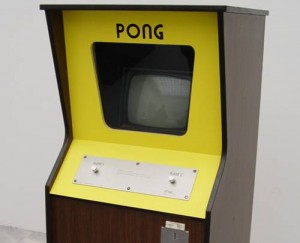
Al Alcorn, one of Atari’s first employees, was the engineer who constructed the first Pong arcade game. The game was named after the desired sound that Bushnell wanted incorporated in the game. The dictionary defines “pong” as a hollow, ringing sound, and this was the sound Bushnell felt was necessary in the game.
The first Pong arcade machine was placed in a local bar in Sunnyvale called Andy Capp’s. It was more of a trial than anything else, as the unit did not even have a fully constructed case. The following is an account of the first night Pong was in this bar, reproduced from “Zap! The Rise and Fall of Atari” by Cohen.
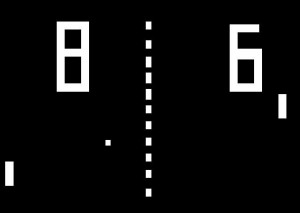
“One of the regulars approached the Pong game inquisitively and studied the ball bouncing silently around the screen as if in a vacuum. A friend joined him. The instructions said: ‘Avoid missing ball for high score.’ One of [them] inserted a quarter. There was a beep. The game had begun. They watched dumbfoundedly as the ball appeared alternately on one side of the screen and then disappeared on the other. Each time it did the score changed. The score was tied at 3-3 when one player tried the knob controlling the paddle at his end of the screen. The score was 5-4, his favor, when his paddle made contact with the ball. There was a beautifully resonant “pong” sound, and the ball bounced back to the other side of the screen. 6-4. At 8-4 the second player figured out how to use his paddle. They had their first brief volley just before the score was 11-5 and the game was over.
“Seven quarters later they were having extended volleys, and the constant pong noise was attracting the curiosity of others at the bar. Before closing, everybody in the bar had played the game. The next day people were lined up outside Andy Capp’s at 10 A.M. to play Pong. Around ten o’clock that night, the game suddenly died.”
The reason for this was that the milk carton coin container inside the machine was overflowing into the electronics. After it was emptied, the game continued its usual operation.
Pong would become a huge hit in the arcades, spawning numerous imitations and several official sequels. Its popularity would not die down, until it was replaced by more advanced systems that used microprocessors instead of LSI (Large Scale Integrated) circuits.

-
Top 10 Shameless Licensed Games
We count down the ten most dangerously cheesy advertisements in video game form!
-
Magnavox Odyssey

Magnavox Odyssey
After the rejection by the military of Raplh Baer’s idea, Baer would spend several years covertly trying to obtain the legal rights to commercially reproduce the game machine he helped design at Sanders Associates in 1966.Eventually the Pentagon became disinterested in the “TV Game” project, and Baer was allowed to pursue the prospect openly. He approached Teleprompter, RCA, Zenith, General Electric, and Magnavox. A deal was struck with RCA, but later fell through because it involved the purchasing of Sanders Associates by RCA. Then in 1970 Bill Enders, who had been a part of the RCA negotiating team, joined Magnavox and persuaded the Magnavox executives to give Baer’s system a chance. The result of this was the production of the Magnavox Odyssey, the first home video game system available to non-military personnel.
The Odyssey had over three hundred seperate parts. It came with hand controls, dice, playing cards, and play money. Plastic overlays which were placed onto the screen by the consumer, provided color playing fields for the various games. The system came preprogrammed with twelve games that utilized all of the aforementioned equipment.
While it could not compete with the Pong units that would be released soon after, the Odyssey did have a very impressive first year, selling over 100,000 units at $100 each.
The real cause for the popularity of the Pong units over the Odyssey was not because of the marketing prowess of competing companies, but rather the creation of low cost LSI (Large Scale Integrated) circuits. These circuits were designed primarily for tennis, hockey, and other Pong-eqsue game mechanics. The low cost LSI’s would allow the market to be flooded by Pong knock-offs.


-
Turbo Grafx 16, Duo, and Express

If any one company seemed poised to commandeer control of the video game industry from Nintendo, it was NEC. With a huge and imposing market share in the computer and communication industries, NEC had been driving their developers since 1988 towards the production of a new video game system. Nintendo’s president Hirosi Yamauchi saw NEC as a threat due to their successful semiconductor business, which would give them
a “direct [and] inexpensive source” for chips. Backed by impressive resources, NEC had been able to saturate any and all industries it wanted, and when the PC-Engine was released in Japan in October of 1987, it appeared as though they would do the same for the video game industry.
After refinement of the PC-Engine it was released in America in 1989, with its name changed to TurboGrafx-16. As the first 16-bit system in a market ready for a new format, the TurboGrafx-16 initially sold quite well, selling more consoles in its first month than its competitors had during the same period.
Video game players are a capricious lot. Trends in popular genres change yearly, with nearly as much modishness as the fashion industry. A particular type of game or system that is popular today, can become an embarrassment to own tomorrow. Unfortunately for NEC, the TurboGrafx-16 was to become the poster-child for this phenomena.
When the Sega Genesis was released, its dramatically more impressive graphics, sound and gameplay turned the TurboGrafx-16 passé overnight. The TurboGrafx became a stigma.

Ultimately, NEC was to blame for this. Having never produced entertainment software before, NEC designers had taken a casual approach to producing games. Many games had all the flash of a 16-bit title, but with little by way of depth of gameplay. NEC also depended on third-party developers to build a library of games. However, most developers were contractually obligated to Nintendo, and could not produce software for NEC. In addition to all of this, the TurboGrafx was not true 16-bit. While its graphics processor was 16-bit, its main CPU was merely 8-bit (a 6820, to be exact).
Despite the poor sales of the TurboGrafx, NEC continued to promote the system. A CD-ROM upgrade made it the first CD console, and a refined, scaled down version would be released as a portable system. Its CD capabilities would give one very well known CD producing company, Working Designs, their start. However, NEC would never achieve much success with their TurboGrafx CD. The reason, as Sheff put it, was that “NEC has arrived too soon with too little.” The TurboGrafx would later be reincarnated as the equally ill-fated TurboDuo, once again in direct competition with Sega. During its life, however, less than 1 million TurboGrafx-16 units were sold.
-
Video Game Vault: Robo Pit
Why do we always equip robots with lethal weaponry?
-
Top 100 Games of All Time

Top 100 Games of All Time
This list of games was compiled by the customers of Player’s Choice.
To affect the outcome of this list go to our contest page and enter
your Top Ten games of all Time.Rank Game System 1 Zelda: Ocarina of Time N64 2 Final Fantasy VII PSX 3 Poke’mon GB 4 Metal Gear Solid PSX 5 Goldeneye 007 N64 6 Super Mario 64 N64 7 Resident Evil 2 PSX 8 Tekken 3 PSX 9 Zelda NES 10 Gran Turismo PSX 11 Final Fantasy VIII PSX 12 Final Fantasy 3 SNES 13 Zelda SNES 14 Super Mario Bros. NES 15 WCW vs. NWO Revenge N64 16 Resident Evil PSX 17 Syphon Filter PSX 18 Super Mario Bros. 3 NES 19 Mario Kart 64 N64 20 Tomb Raider PSX 21 Sonic GEN 22 Super Smash Bros. N64 23 Parasite Eve PSX 24 Final Fantasy NES 25 WWF Warzone PSX 26 South Park N64 27 Castlevania PSX 28 Turok 2 N64 29 Silent Hill PSX 30 Final Fantasy Tactics PSX 31 Contra NES 32 Sonic Adventure DC 33 Super Metroid SNES 34 Twisted Metal 3 PSX 35 Tomb Raider 2 PSX 36 Twisted Metal 2 PSX 37 Mario Party N64 38 Super Mario World SNES 39 1080 Snowboarding N64 40 WWF Attitude N64 41 Star Wars Rogue Squadron N64 42 Need for Speed 4 PSX 43 Zelda Links Awaikening GB 44 Banjo-Kazooie N64 45 WWF Warzone N64 46 Xenogears PSX 47 Soul Calibar DC 48 Secret of Mana SNES 49 Super Mario Kart SNES 50 Final Fantasy 2 SNES 51 Crash Bandicoot 3:Warped PSX 52 Donkey Kong Country SNES 53 Tomb Raider 3 PSX 54 Super Mario RPG SNES 55 Star Wars: Episode 1 Racer N64 56 Need For Speed 3 PSX 57 WWF Attitude PSX 58 Lunar Silver Star Story PSX 59 NFL Blitz PSX 60 Tenchu PSX 61 Donkey Kong Country 2 SNES 62 Street Fighter Alpha 3 PSX 63 Driver PSX 64 Spryo the Dragon PSX 65 Warcraft 2 PC 66 Earthbound SNES 67 Coolboarders 3 PSX 68 Twisted Metal PSX 69 Mike Tyson’s Punch-Out NES 70 NFL Blitz N64 71 Donkey Kong N64 72 WCW Thunder PSX 73 Chrono Trigger SNES 74 WWF Wrestlemania 2000 N64 75 Pokemon Pinball GB 76 Lunar, the Eternal Blue SCD 77 Metroid NES 78 NFL 2K DC 79 Mortal Kombat Trilogy PSX 80 NBA Live 99 PSX 81 Army Men 3D PSX 82 Tekken 2 PSX 83 Mortal Kombat 4 PSX 84 Mega Man NES 85 Street Sk8ter PSX 86 Fighting Force PSX 87 Gauntlet Legends N64 88 Suikoden PSX 89 Star Wars: SOTE N64 90 Sonic 2 GEN 91 Grand Theft Auto PSX 92 Breath of Fire 3 PSX 93 Diddy Kong Racing N64 94 Beetle Adventure Racing N64 95 Resident Evil 3: Nemesis PSX 96 House of the Dead 2 DC 97 Half-Life PC 98 Tetris DX GB 99 Street Fighter 2 SNES 100 WipeOut XL PSX